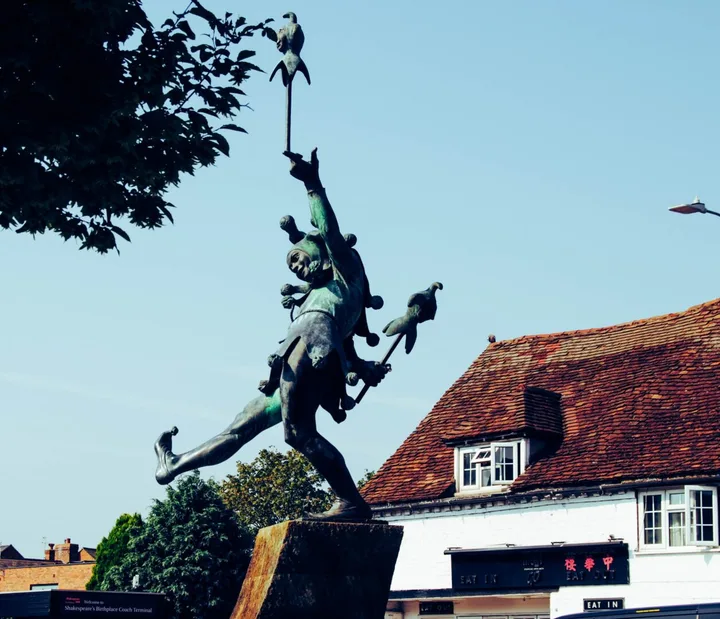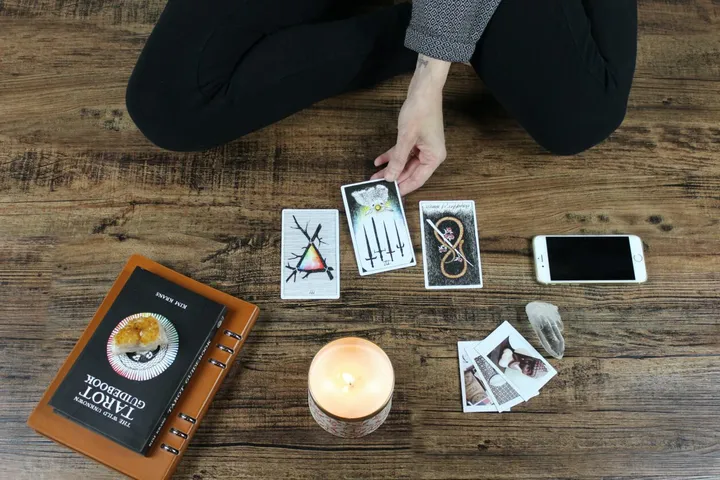
The Fool’s Journey is a way of studying the Major Arcana as a connected story. The Fool begins an unfamiliar path, meets the experiences represented by the other cards and reaches the World, where a cycle comes together. The story helps you remember the cards and notice how their themes relate.
It is an interpretive framework, not a rule that every life or reading follows the cards in numerical order. You can encounter a Tower experience after a World achievement, or return to the Magician when a new undertaking needs your skills. The journey can describe a whole life, a spiritual passage or one smaller change within it.
Follow the order of your deck
This guide uses Rider-Waite-Smith numbering: the Fool is 0, Strength is VIII, Justice is XI and the World is XXI. The usual Marseille order places Justice at VIII and Strength at XI. Other decks may change titles or arrangements, so keep your own deck’s sequence beside you.
The Fool remains the traveller in this teaching story even when you study the cards in three groups of seven: I to VII, VIII to XIV and XV to XXI. Zero stands outside those groups. The grouping is a study method; you do not need to divide an actual spread into those stages.
Beginning: the Fool and cards I to VII
Lay out the Fool, then the Magician through the Chariot. This part of the story concerns entering the world and learning how to act within it. Abilities, intuition, care, authority and tradition lead toward choice and purposeful movement.
| Number and card | What it brings to the journey |
|---|---|
| 0. The Fool | An opening invites trust and curiosity, with risks still to be understood. |
| I. The Magician | Skills and available resources give the beginning a way to take form. |
| II. The High Priestess | The traveller encounters inner knowledge and what has not yet been revealed. |
| III. The Empress | Care, creativity and abundance show how life can be nourished. |
| IV. The Emperor | Structure and authority give a place to stand and responsibilities to meet. |
| V. The Hierophant | Teaching, shared beliefs and tradition introduce a wider community. |
| VI. The Lovers | Relationship and meaningful choice ask the traveller to recognise what they value. |
| VII. The Chariot | Direction and determination bring those influences into purposeful movement. |
These cards can describe different parts of starting a course or entering a new community. You arrive with the Fool’s openness, develop the Magician’s skills and meet the Hierophant’s teaching. The Lovers may bring a choice about what you want to commit to; the Chariot asks whether you can give it a direction.
Those are examples of the sequence’s relationships. In a spread, each card still answers the position in which it appears.
Reconsidering: cards VIII to XIV
The next seven cards turn toward endurance, examination and change. Progress can bring questions about what the traveller has achieved and how they have achieved it. A pause or loss may alter the direction of the journey.
| Number and card | What it brings to the journey |
|---|---|
| VIII. Strength | Courage and patient self-command help the traveller meet difficult impulses or circumstances. |
| IX. The Hermit | Solitude and guidance make room to search for a more considered answer. |
| X. Wheel of Fortune | Changing conditions reveal the movement of cycles beyond personal control. |
| XI. Justice | Decisions, fairness and consequences ask for an honest reckoning. |
| XII. The Hanged Man | Suspension or surrender makes another perspective possible. |
| XIII. Death | An ending clears a stage of life or an arrangement that can no longer continue. |
| XIV. Temperance | Adjustment and integration bring different experiences into a workable balance. |
Strength and Justice have separate jobs here. Strength concerns how you meet a difficulty; Justice concerns judgement and consequences. Keeping those meanings distinct is useful even if your deck places them in the opposite numerical order.
The Hanged Man, Death and Temperance can be studied as a pause, a release and a period of adjustment. That relationship can help you understand change. It does not mean those three cards must arrive together or that one difficult card predicts the whole sequence.
Wider change: cards XV to XXI
The final group includes attachment, disruption, renewed hope and the search for clarity. It ends with the World, where the experience finds completion or integration. The end of one cycle can make room for another Fool beginning.
| Number and card | What it brings to the journey |
|---|---|
| XV. The Devil | Attachment and dependence reveal where freedom has become difficult to exercise. |
| XVI. The Tower | Disruption breaks an unstable structure or exposes what it could not support. |
| XVII. The Star | Hope and renewal give the traveller a direction after difficulty. |
| XVIII. The Moon | Uncertainty, intuition and obscured information require care in finding the way. |
| XIX. The Sun | Clarity, vitality and success bring an experience into the open. |
| XX. Judgement | A call, awakening or reckoning asks the traveller to respond to what has become clear. |
| XXI. The World | A cycle reaches fulfilment, with its parts brought together. |
The Tower and Star make a useful comparison: one shows a structure failing, the other the hope and orientation that can follow. The Moon and Sun compare uncertainty with clarity. Studying neighbouring cards lets you see their differences as well as their connection.
Use the journey in a reading
A Major Arcana card can describe an important development, spiritual lesson, person or condition in the position it occupies. The journey gives that theme a wider context. It does not replace the question, orientation or other cards.
Imagine asking, “How is my recovery from this failed project developing over the next month?” You draw past, present and future. In this hypothetical reading, all cards are upright.
| Position | Card | A possible interpretation |
|---|---|---|
| Past | The Tower | The project fell apart, exposing weaknesses in what you had built. |
| Present | The Star | Hope is returning and a direction is becoming visible. |
| Future | The Sun | Greater clarity and confidence are likely to develop, with a more encouraging outlook. |
The journey helps connect disruption with renewal and clarity. The spread supplies the timing: the Tower describes the past, the Star the present and the Sun the month ahead. The Moon is absent, so you do not insert a period of confusion simply because it comes between the Star and Sun in the deck.
Reversals can complicate how a stage is expressed. A reversed Chariot may show direction breaking down rather than progress. Use your chosen reversal method and the card’s established meaning. The journey alone does not supply a separate universal meaning for every reversed Major.
Study a short stretch of the sequence
Choose three neighbouring Majors and place them in numerical order. Write a brief account of what changes between the cards. Then look up each individual guide and check whether your account preserves its meaning.
Finally, change the order. What would Temperance before Death suggest that Death before Temperance would not? Treat this as a study exercise, separate from a drawn reading. Record both versions in your journal, so the story helps you remember the cards without fixing them to one path.
Further reading
Joan Bunning’s Fool’s Journey presents the life-journey framework. A. E. Waite’s chapters on Strength and Justice establish their Rider-Waite-Smith numbering. Our linked card guides above supply the individual meanings used in this account.