

Keywords
Upright: Tradition, teaching, shared beliefs, institutions, belonging.
Reversed: Questioning convention, restrictive rules, conformity, independence.
Overview
Most of what we learn comes through other people. Families, schools and communities pass on ideas about how to live. The Hierophant, card 5 of the Major Arcana, concerns himself with that shared knowledge and the rules that hold a group together.
His setting is religious, but his meaning extends to any institution with established roles and practices. He can describe a teacher, a course of study or a community whose values you share.
Belonging has benefits, and it has a cost. A tradition may help you understand your experience, or ask you to accept something you no longer believe. The Hierophant brings that tension into a reading: what can you learn from the group, and where do you need to think for yourself?
A Closer Look at The Hierophant
Description
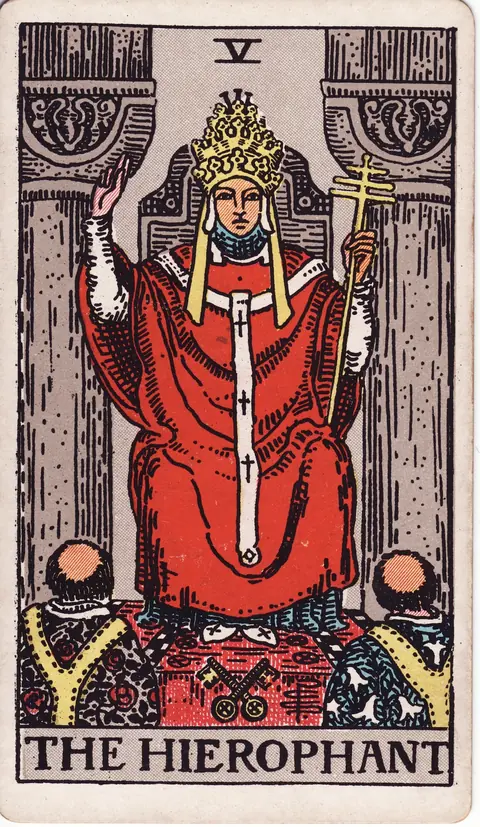
The Hierophant sits between two grey pillars, wearing ceremonial robes and a three-tiered crown. His right hand is raised in blessing, and his left holds a staff with three crossbars. Two students kneel before him. Crossed keys lie at his feet.
The scene suggests initiation into an established tradition. The students are receiving teachings that existed before them and will continue after them. Roses and lilies on their clothing bring together love and purity.
Also called the High Priest or Pope in some decks, the Hierophant is associated with Taurus. He offers a useful comparison with the High Priestess: she listens inwardly, while he teaches through a shared system.
Meaning
The Hierophant concerns learning, values and the authority of tradition. The question is whether the system supports your growth or simply expects your compliance.
Upright
Upright, the Hierophant indicates organised spiritual authority, shared moral principles and a well-ordered community. He favours learning from an experienced teacher or adviser.
In a favourable spread, he can predict a good reputation and social standing, or represent a skilled negotiator, spiritual arbitrator or moral authority. Membership in a group brings support and a shared identity, together with responsibility to its principles.
Reversed
Reversed, the Hierophant indicates a break with tradition and the status quo. You may question inherited beliefs or choose a life your community does not readily understand.
He can also warn of gossip, defamation and loss of reputation. First impressions and socially approved opinions can become misleading. An authority that demands conformity without spiritual guidance may be part of the difficulty. The question and surrounding cards distinguish independence from the restrictive side of group life.
The Symbolism of The Hierophant
- The two students: Learning through relationship and initiation into a community. Knowledge is passed between people.
- The grey pillars: The enduring structure of an institution, with the possibility that stability becomes inflexibility.
- The three-tiered crown: Spiritual authority expressed through a hierarchy. Its repeated levels suggest different realms of experience.
- The staff with three crossbars: The Hierophant’s role as a spiritual guide and the responsibility that comes with it.
- The raised hand: A blessing, connecting spiritual teaching with actions in the world.
- The crossed keys: Access to understanding. They connect conscious and unconscious knowledge in this symbolic reading.
- The roses and lilies: Love and purity as ideals underlying the outward ceremony.
- The ceremonial robes: A role defined by tradition. They distinguish the teacher’s office from his personal identity.
- The number five: The fifth essence, or the meaning that gives life to the outward forms of belief.
What The Hierophant Means in a Reading
Meaning for Love and Relationships
Upright
The Hierophant foreshadows a wedding or another traditional ceremony of commitment. He is a favourable sign when you want a conventional partnership, understood according to your own community and values.
Discuss what commitment means to each of you. If your relationship is unconventional, the card can indicate concern about other people’s approval and the consequences of going against their expectations. Shared values help you decide how much influence that approval should have.
Reversed
Reversed, the Hierophant can indicate an unconventional relationship, a decision not to marry or a change in traditional gender roles. The arrangement may suit you even when it differs from the expected pattern.
He can also predict conflict and insecurity when partners do not share beliefs or future goals. Listen to each other’s perspective and seek a compromise that neither person experiences as abandoning their values.
Meaning for Career
Upright
At work, the Hierophant favours training, mentorship and learning how an organisation operates. Established procedures may give you a useful starting point, especially when you are new to a role.
If you want a mentor, approach someone whose judgement you respect with a specific question. Apply what is useful and let them know how it went. The card’s emphasis is on learning through experience that another person can share.
Reversed
A rule may be restricting the work it was meant to support. The reversed Hierophant can describe pressure to follow a manager’s instructions or a group consensus that conflicts with your principles.
Identify what you are being asked to accept and why it troubles you. You may need to question a procedure, a teaching or the culture around you. A disagreement becomes clearer when you can explain the value at stake.
Meaning for Health and Well-Being
Upright
The Hierophant favours established treatment and guidance from experienced practitioners. If you have been ignoring a problem, his appearance urges you to follow a proper course of care and take the advice seriously.
Routine and consistency matter. This card brings the support of knowledge passed down through a trusted tradition, and asks you to make use of it.
Reversed
Reversed, the Hierophant can show dissatisfaction with an established approach. A different perspective or a second opinion may help you find a way forward.
His message is to question what has become automatic and explore the options available to you. A longstanding concern may benefit from a second opinion, massage or closer attention to diet and medication with an appropriate practitioner. A more esoteric approach can also have a place alongside the care you need. Seek an approach you understand and can participate in, rather than following a routine without conviction.
Meaning for Finances
Upright
The Hierophant favours traditional money management and learning from experience. Established methods, steady saving and prudent decisions offer the strongest foundation now. He asks you to examine the financial beliefs you have inherited as carefully as the choices you make.
Money also expresses your values. Consider whether your spending serves what matters to you or simply wins social approval. The desire to keep up appearances can undermine an otherwise sound position.
Reversed
In a financial reading, the reversed Hierophant still favours a practical, traditional approach. Gambling and speculative ventures are unlikely to pay off now. The card instead favours prudent, consistent investments and guidance from someone with financial experience.
Do not mistake a break with social expectations for a reason to disregard sound judgement. Understand the arrangement before committing to it.
Timing
The Hierophant foresees an event that may arrive unexpectedly, although the exact time is uncertain. His Taurus association brings the date range April 21 to May 20.
The event may concern learning, an institution or guidance from someone with experience.
Yes or No Questions
The Hierophant generally gives a maybe. He asks what guidance, knowledge or agreement you need before deciding.
Upright, an established route may support your intention. Reversed, the question may require you to challenge an expectation or choose according to your own considered beliefs.