
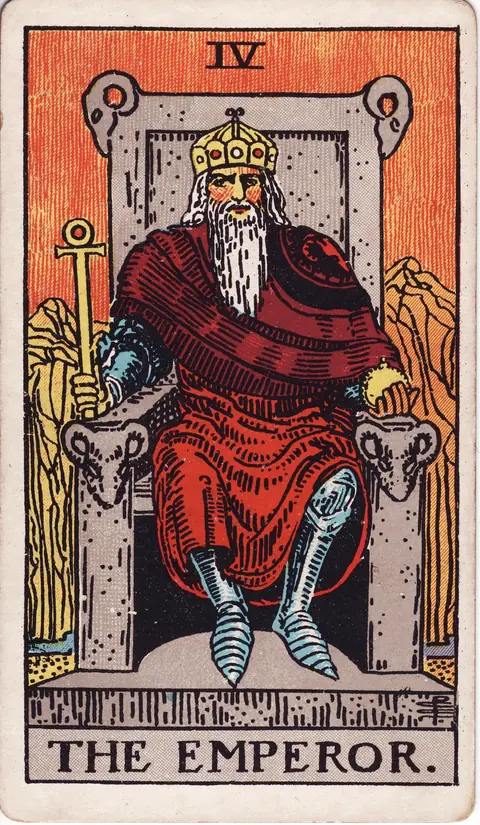
Astrology can explain another layer of tarot’s symbolism. The Emperor’s ram heads connect him with Aries. The High Priestess belongs to the Moon in the Golden Dawn correspondence system. The Three of Swords has the more specific assignment of Saturn in Libra.
These connections help you compare cards and refine a reading’s message. Start with the card’s established meaning, then use its astrological correspondence where it clarifies the question. You do not need a birth chart to learn this part of tarot.
Which correspondence system are we using?
This guide follows the Golden Dawn scheme recorded in Book T, using familiar Rider-Waite-Smith card names. It assigns the Majors to twelve zodiac signs, seven traditional planets and three elemental correspondences. The World also has an Earth association alongside Saturn.
Tarot traditions differ. A Marseille deck does not automatically use this entire scheme, and modern deck creators may explain their own assignments. Thoth tarot shares much of the Golden Dawn framework but changes some names and other correspondences. Read your deck’s guidebook when its symbolism differs from the table here.
In the traditional astrological vocabulary, the Sun and Moon are included among the seven planets. That is the terminology of the correspondence system, rather than a claim about their classification in astronomy.
A zodiac sign, a planet and another zodiac sign
Compare three astrological assignments that can form a reading about authority, disruption and recovery. The positions make the message specific.
Aries
The Emperor
Initiative and authority establish a structure.
Mars
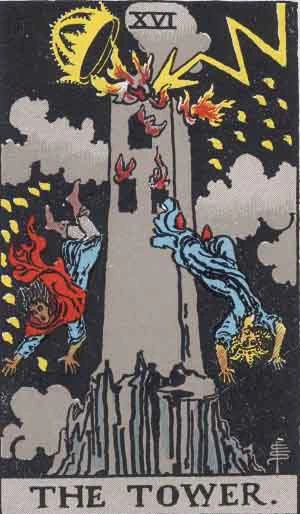
The Tower
An abrupt disruption breaks or exposes an established structure.
Aquarius
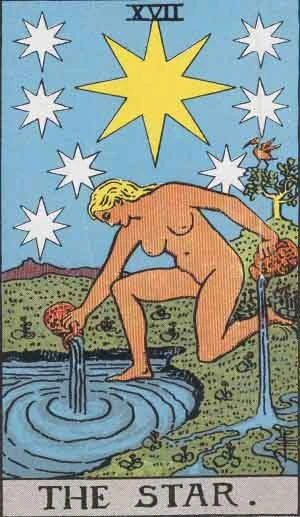
The Star
Renewal gives room for a more hopeful future.
Use the correspondence to clarify the card
The Emperor is assigned to Aries, while the Tower has the direct Mars correspondence. Mars also rules Aries, which connects the cards without making their messages identical. The Star introduces a different direction through its Aquarius assignment.
When these cards describe the present, challenge and likely development, the reading can distinguish established authority from an incoming disruption and a possible recovery. Knowing the assignments does not establish any current planetary transit.
The Major Arcana correspondence table
The numbering here is Rider-Waite-Smith: Strength at VIII and Justice at XI. The assignments are attached to the named cards. Switching the printed numbers in another tradition does not by itself turn Strength’s Leo correspondence into Justice’s Libra correspondence.
Scroll sideways to read every column.
| Card | Golden Dawn correspondence | A theme to examine in the card |
|---|---|---|
| Fool, 0 | Air | Openness, movement and an uncommitted possibility. |
| Magician, I | Mercury | Skill, communication and purposeful use of tools. |
| High Priestess, II | Moon | Receptivity, hidden knowledge and intuition. |
| Empress, III | Venus | Attraction, fertility and the enjoyment of what grows. |
| Emperor, IV | Aries | Initiative, authority and the force that establishes a direction. |
| Hierophant, V | Taurus | Established values, continuity and a teaching given form. |
| Lovers, VI | Gemini | Relationship, duality and a significant choice. |
| Chariot, VII | Cancer | Protection and direction amid different pressures. |
| Strength, VIII | Leo | Courage, vitality and a deliberate response to powerful feeling. |
| Hermit, IX | Virgo | Discernment, study and careful attention. |
| Wheel of Fortune, X | Jupiter | Opportunity, expansion and turning fortune. |
| Justice, XI | Libra | Balance, judgement and the consequences of a decision. |
| Hanged Man, XII | Water | Surrender, suspension and a changed perspective. |
| Death, XIII | Scorpio | Endings and a transformation that changes the situation. |
| Temperance, XIV | Sagittarius | Integration and a direction found through different influences. |
| Devil, XV | Capricorn | Material ambition, binding conditions and their costs. |
| Tower, XVI | Mars | Rupture, conflict and force that breaks an established structure. |
| Star, XVII | Aquarius | Renewal and the possibility of a different future. |
| Moon, XVIII | Pisces | Dreams, uncertainty and impressions that need careful reading. |
| Sun, XIX | Sun | Clarity, vitality and visible success. |
| Judgement, XX | Fire and Spirit | Awakening, a summons and a decisive response. |
| World, XXI | Saturn and Earth | Completion, limits and an achievement given lasting form. |
The final column gives interpretive starting points. Follow each card link for its full upright and reversed meanings, including love, work, health, money and timing.
A card’s name is not always its planet
The High Priestess is the Moon’s planetary card in this system. The tarot card called the Moon corresponds to Pisces. Both can concern intuitive or hidden experience, but their astrological assignments are different.
The Emperor corresponds to Aries. Mars rules Aries in traditional astrology, but the Major directly assigned to Mars is the Tower. Aries can help explain the Emperor’s initiative and forceful authority without making the Emperor and Tower interchangeable.
The same distinction applies to the Devil and World. Capricorn is the Devil’s zodiac sign; Saturn rules Capricorn. The World has the direct Saturn assignment. Keep a card’s correspondence and its sign’s ruler in separate columns when you make notes.
Elements connect the four suits
In this tradition, Wands belong to Fire, Cups to Water, Swords to Air and Pentacles to Earth. Fire signs are Aries, Leo and Sagittarius; Water signs are Cancer, Scorpio and Pisces; Air signs are Gemini, Libra and Aquarius; Earth signs are Taurus, Virgo and Capricorn.
Those groups give each suit a wider astrological setting. The numbered cards then receive particular planet-and-sign assignments through the thirty-six decans. The Three of Wands is Sun in Aries, while the Six of Wands is Jupiter in Leo. Their shared Fire suit does not erase those differences.
Court cards combine a suit element with a rank element in some systems. Their zodiacal territories and titles need a separate explanation, so use the court-card astrology lesson before assigning a person an exact sign from a court card.
Worked reading: authority, disruption and recovery
Imagine asking, “What is developing in this organisation over the next two months?” Choose the established situation, incoming challenge and likely direction. This hypothetical example uses upright cards.
Scroll sideways to read every column.
| Position | Card | Reading |
|---|---|---|
| Established situation | Emperor | Authority and rules give the organisation structure, with decisions concentrated in established leadership. |
| Incoming challenge | Tower | A disruption may expose a weakness in that structure or force an abrupt change. |
| Likely direction | Star | The outlook favours renewed hope and a more open view of what can be rebuilt. |
Aries, Mars and Aquarius help distinguish the force used to establish the structure, the force that breaks it and the possibility that follows. The forecast still comes from the cards in their positions. You would not need to invent a current Mars transit to justify the Tower.
If the Star were reversed, the likely direction might involve discouragement or difficulty trusting the recovery. Its Aquarius correspondence would remain, while orientation changes how the card’s possibilities are expressed.
Can astrology help with timing?
A reader can choose to use a zodiac sign or decan as a timing indicator. That needs a timing question and a stated method. An Emperor drawn as advice can ask for decisive leadership without also predicting an event during Aries season.
Decans are divisions of zodiacal longitude. Calendar dates are approximate and depend on the zodiac and conversion method used. If you use them to forecast a window, note whether you are using a tropical or sidereal system and check the relevant year’s boundaries. The decan lesson explains the degree ranges without turning them into universal dates.
Modern outer-planet assignments
Some later tarot systems connect the Fool with Uranus, the Hanged Man with Neptune and Judgement with Pluto. The Book T table above retains their elemental assignments. These are different versions of the framework, so label the version you are using instead of treating both as one original table.
An outer-planet association can be useful in a deck designed around it. It does not require replacing the elemental reading whenever one of those cards appears.
Choose your next lesson
Study tarot and the twelve zodiac signs if you want to work with the zodiacal Majors. Use tarot decans to examine the numbered Minor Arcana. Continue to court cards and astrology when you want to compare the courts’ elemental qualities and zodiacal ranges.
In a reading, use the smallest amount of correspondence knowledge that makes the answer clearer. A precise explanation of one card is more useful than a list of every symbol associated with it.
Sources and further reading
The primary correspondence table is in the Golden Dawn’s Book T, “The Titles of the Symbols”. Robert Wang’s The Qabalistic Tarot discusses its symbolic framework. Mary K. Greer’s account of Golden Dawn correspondences explains why different tarot lineages and later teachers use different assignments. The worked reading is a teaching example, not a report of an actual consultation.