
Court-card astrology is more complicated than assigning one zodiac sign to each figure. In the Golden Dawn system, a court combines an elemental quality with its suit, and some courts govern a thirty-degree span that crosses from one sign into another.
The names also change between decks and teaching systems. A King in one source may occupy the role called Knight or Prince in another. Before applying an astrological table, check which figure and elemental rank its author means.
Start with the suit element
The Golden Dawn suit assignments are Wands as Fire, Cups as Water, Swords as Air and Pentacles as Earth. These connect with the same element groups described in our zodiac-sign guide.
A Cups court therefore has a Water concern, but its exact role still depends on rank and position. A Page may announce a new feeling, a Knight an invitation, a Queen emotional understanding and a King mature guidance in the Rider-Waite-Smith approach used by our court-card meanings guide.
Those practical meanings are a useful foundation even if you choose not to use astrological territories.
Two Queens, two expressions of understanding
The Golden Dawn Queens have a Water rank element. Comparing Cups with Swords lets you study how that rank operates through different suits.
Water of Water
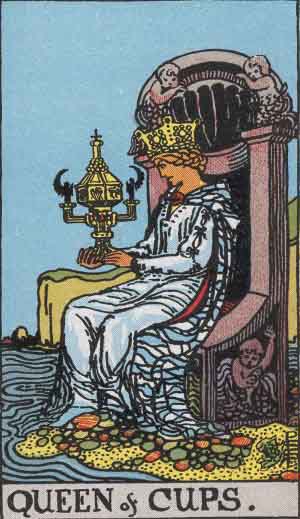
Queen of Cups
Attend to feelings and listen with emotional understanding.
Water of Air
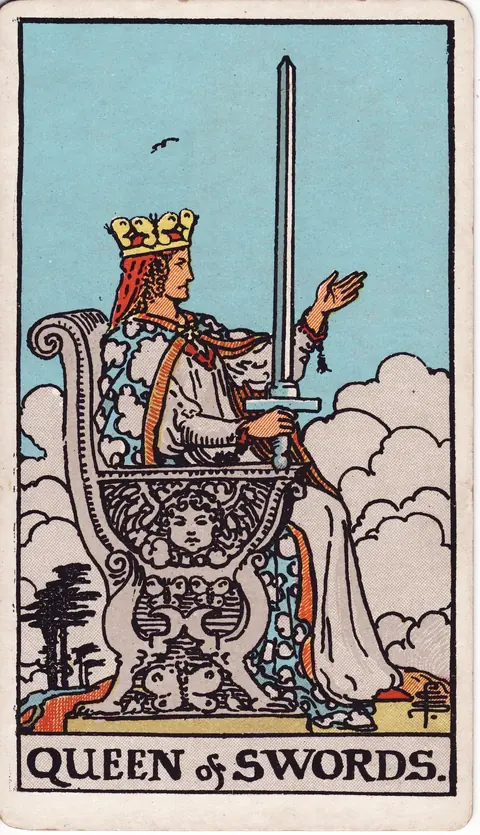
Queen of Swords
Bring understanding into clear speech, judgement and boundaries.
One person can use both approaches
These Queens can describe different people, but they can also describe two responses within the same person. A conversation may need both careful listening and a direct statement of what is acceptable. The positions explain how each response belongs in the reading.
The elemental formulas are the Golden Dawn arrangement used in this lesson. Keep them distinct from zodiacal territories and from a person's whole birth chart. The cards can give advice without identifying anyone's Sun sign.
Why court titles cause conflicting tables
In Book T, the mounted fiery ruler is listed as a Knight and also described as a King. The chariot figure has the esoteric title Prince, while the initial card list calls him King. The lowest court is called Knave or Princess. Thoth uses Knight, Queen, Prince and Princess; Rider-Waite-Smith uses King, Queen, Knight and Page.
Matching only the word “King” between two tables can therefore connect different elemental ranks. Matching only a mounted picture can also fail when a later teacher has reassigned the ranks. Read the author’s description and conversion rules before copying the correspondence.
The table below names the roles in Book T. It is not a universal conversion table for every Rider-Waite-Smith deck.
Scroll sideways to read every column.
| Golden Dawn role | Titles encountered in Book T | Rank element |
|---|---|---|
| Mounted ruler | Knight in the card list; also called King in the descriptions | Fire |
| Enthroned Queen | Queen | Water |
| Chariot figure | Prince in the descriptions; King in the card list | Air |
| Lowest court | Knave or Princess | Earth |
Robert Wang compares these court structures in The Qabalistic Tarot. If your deck’s book gives another arrangement, use that arrangement consistently and label it in your notes.
Combine rank and suit elements
The first element describes the rank, and the second the suit. In the Golden Dawn arrangement, the Queen of Wands is Water of Fire. The Queen of Cups is Water of Water, the Queen of Swords Water of Air and the Queen of Pentacles Water of Earth.
These phrases help you ask how an element is handled. Water of Fire can suggest a receptive or sustaining relationship with enthusiasm and will. Water of Earth can suggest care expressed through practical resources and the conditions of daily life. They are symbolic study approaches, not literal mixtures.
The Queen of Swords shows why two elements should not become one simplistic keyword. Her Water rank does not erase her discernment, direct speech and boundaries. Read the card’s actual image and meaning alongside the formula.
Zodiac ranges cross sign boundaries
The mounted rulers, Queens and Princes in Book T each govern three decans, or thirty degrees. Their ranges begin in the last ten degrees of one sign and continue through the first twenty degrees of the next. They therefore cover parts of two signs.
The four Queens provide a clear group to study because their titles remain recognisable in the compared systems. The ranges below are the Book T assignments, with the start included and the final boundary excluded.
Scroll sideways to read every column.
| Queen | Elemental formula | Zodiacal range |
|---|---|---|
| Queen of Wands | Water of Fire | From 20 degrees Pisces to before 20 degrees Aries |
| Queen of Cups | Water of Water | From 20 degrees Gemini to before 20 degrees Cancer |
| Queen of Swords | Water of Air | From 20 degrees Virgo to before 20 degrees Libra |
| Queen of Pentacles | Water of Earth | From 20 degrees Sagittarius to before 20 degrees Capricorn |
Calling the Queen of Cups simply “Cancer” leaves out the last decan of Gemini. Calling her “all Water signs” uses a broader elemental association instead of this specific zodiacal range. Either can be a chosen study method, but they answer different questions.
The Princesses and Aces have another arrangement of elemental quadrants and celestial regions. They are not assigned one ordinary thirty-degree sign span in this scheme. A chart that gives every Page a single sign needs to explain the different method behind it.
A court card does not establish a person’s Sun sign
A Queen of Cups drawn as advice can call for emotional understanding. In a future position, a court may describe a person approaching or an emotional influence developing. Neither use requires the person involved to have a Cancer Sun.
If you deliberately use zodiacal ranges to select a significator, choose which birth-chart factor you are matching. A Sun, Moon or Ascendant can occupy different places, so the same person may connect with more than one court through that study method.
Astrological correspondence does not establish someone’s gender, age or physical appearance. Read the qualities and circumstances that fit the question instead of forcing a person into a historical portrait.
Worked example: two Queens in a reading
Imagine asking, “What will help me handle this conversation with a close friend?” Draw the Queen of Cups for what to understand and the Queen of Swords for how to respond. Both are upright in this hypothetical example.
The Queen of Cups asks you to recognise the feelings involved and listen carefully. The Queen of Swords asks you to speak clearly and keep an appropriate boundary. In the elemental comparison, Water of Water attends to the emotional experience, while Water of Air brings that understanding into words and judgement.
The pair can describe two approaches within you. It need not identify two separate people or forecast a conversation in two zodiac seasons. If the Queen of Cups is reversed, emotional overwhelm or excessive accommodation may complicate the advice; the Queen of Swords can still support a clear response.
Compare sources without losing your method
When two books give different assignments, note the deck, the court titles, the rank elements and the zodiacal ranges. First check whether the authors are naming the same role differently. If the roles genuinely differ, retain the distinction rather than combining half of each table.
You can keep the full astrological framework for study while giving a reading in ordinary language. The person receiving it needs to understand the court’s message, such as emotional support, a clear boundary or an approaching invitation. A list of elemental formulas alone does not answer the question.
Sources and further reading
The elemental roles and Queen ranges come from the Golden Dawn’s Book T, court-card titles and descriptions. Robert Wang’s The Qabalistic Tarot compares the courts in different decks. Our court-card interpretation guide supplies the practical Rider-Waite-Smith reading approach used in the worked example.