A decan is a ten-degree section of the zodiac. Each of the twelve signs contains three, giving thirty-six decans altogether. In the Golden Dawn tarot system, they correspond to the thirty-six numbered Minor Arcana from Two through Ten across the four suits.
Each card receives a planet and sign: the Two of Cups is Venus in Cancer, the Three of Swords is Saturn in Libra and the Eight of Pentacles is Sun in Virgo. These assignments help explain why cards within the same suit or sign have different messages.
How the system fits the deck
Each suit has nine cards from Two through Ten. Four suits multiplied by nine cards gives thirty-six. The Aces represent elemental roots and are not part of this particular decan sequence. The court cards have separate assignments, explained in court cards and astrology.
The sign determines the suit through its element: Fire gives Wands, Water gives Cups, Air gives Swords and Earth gives Pentacles. Within each element, the cardinal sign receives Two, Three and Four; the fixed sign receives Five, Six and Seven; the mutable sign receives Eight, Nine and Ten.
That places the Two through Four of Wands in Aries, Five through Seven in Leo, and Eight through Ten in Sagittarius. The other suits follow the same number pattern through their signs.
Compare the three decans of Cancer
These Cups cards share a Water sign, while each decan has its own planet. Their scenes show different expressions within the emotional life.
First decan: Venus
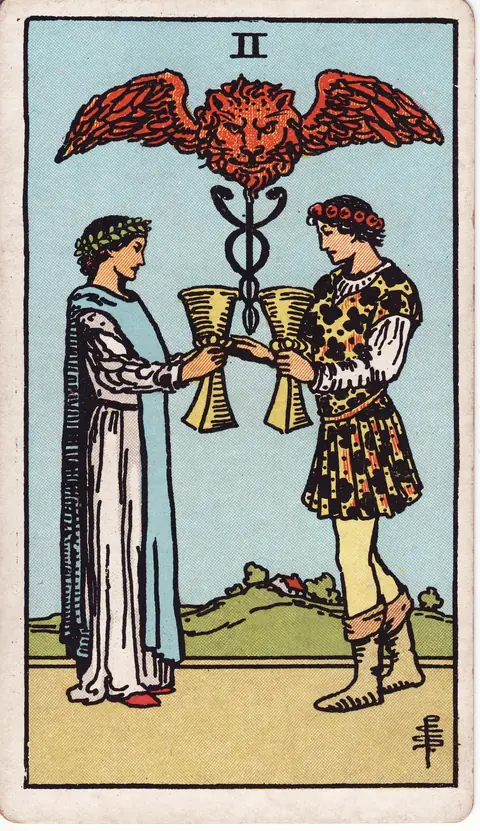
Two of Cups
Attraction and mutual connection bring two people together.
Second decan: Mercury
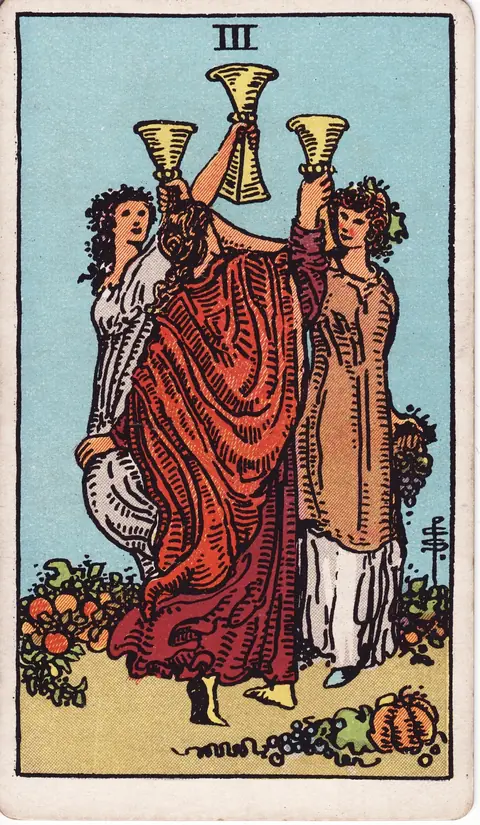
Three of Cups
Exchange and shared celebration support the connection.
Third decan: Moon
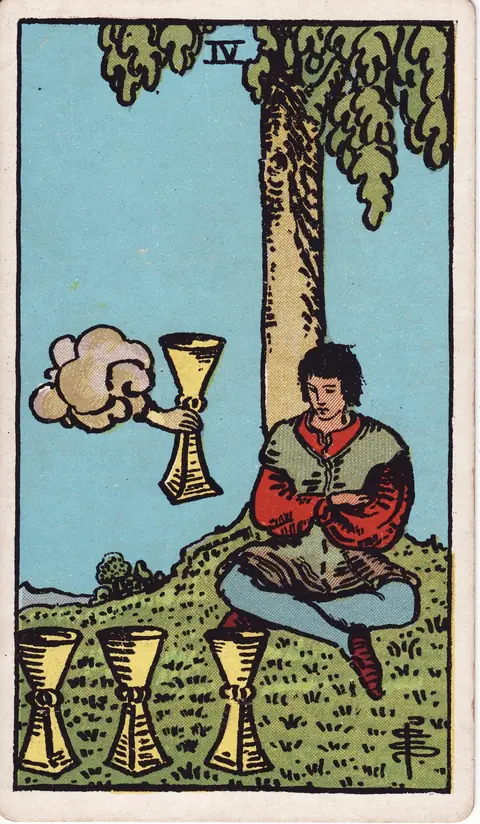
Four of Cups
An inward emotional state may become withdrawal or dissatisfaction.
A shared sign does not give an identical forecast
The Two can show a bond, while the Three brings shared time and support. The Four asks you to examine what happens when attention turns inward or an offer is missed. Cancer connects the cards, but the planets and scenes help distinguish them.
In a spread, read each card through its position. A Two as the foundation and Four as likely development can describe an existing connection followed by disengagement. The shared sign does not turn the Four into the same favourable message as the Two.
The complete thirty-six-card table
The first decan runs from 0 degrees up to, but not including, 10. The second begins at 10 and ends before 20. The third begins at 20 and ends before 30, where the next sign starts. A position at exactly 10 degrees therefore belongs to the second decan.
Each entry below names a card followed by its decan ruler. The zodiac sign at the left supplies the other half of the planet-in-sign correspondence. The table follows Book T, rather than a different decan-rulership method.
Scroll sideways to read every column.
| Sign | First decan: 0 to under 10 degrees | Second: 10 to under 20 degrees | Third: 20 to under 30 degrees |
|---|---|---|---|
| Aries | Two of Wands, Mars | Three of Wands, Sun | Four of Wands, Venus |
| Taurus | Five of Pentacles, Mercury | Six of Pentacles, Moon | Seven of Pentacles, Saturn |
| Gemini | Eight of Swords, Jupiter | Nine of Swords, Mars | Ten of Swords, Sun |
| Cancer | Two of Cups, Venus | Three of Cups, Mercury | Four of Cups, Moon |
| Leo | Five of Wands, Saturn | Six of Wands, Jupiter | Seven of Wands, Mars |
| Virgo | Eight of Pentacles, Sun | Nine of Pentacles, Venus | Ten of Pentacles, Mercury |
| Libra | Two of Swords, Moon | Three of Swords, Saturn | Four of Swords, Jupiter |
| Scorpio | Five of Cups, Mars | Six of Cups, Sun | Seven of Cups, Venus |
| Sagittarius | Eight of Wands, Mercury | Nine of Wands, Moon | Ten of Wands, Saturn |
| Capricorn | Two of Pentacles, Jupiter | Three of Pentacles, Mars | Four of Pentacles, Sun |
| Aquarius | Five of Swords, Venus | Six of Swords, Mercury | Seven of Swords, Moon |
| Pisces | Eight of Cups, Saturn | Nine of Cups, Jupiter | Ten of Cups, Mars |
The table describes symbolic assignments. Drawing the Three of Swords does not establish that Saturn is currently in Libra. To discuss an actual transit, you would need the relevant astrological information separately.
Why the planets follow this pattern
The scheme uses the repeating planetary order Saturn, Jupiter, Mars, Sun, Venus, Mercury and Moon. When arranged beginning with Saturn in the first decan of Leo, the assignments continue around the zodiac. Mars rules both the last decan of Pisces and the first of Aries at the point where the thirty-six-part circle closes.
This is often called the Chaldean order. Astrology also has other ways of assigning decan rulers. Replacing these rulers with a different sequence would produce a different table, so name the system whenever you compare sources.
You can use the tarot table without memorising the sequence. Learning three cards within one sign is a more manageable first step.
Read the card before adding the correspondence
The Three of Swords shows a painful division or truth. Saturn in Libra gives a symbolic way to examine limitation, consequence and strain within a relationship or agreement. It does not require you to invent a romantic betrayal when the question concerns a contract or friendship.
The Nine of Cups has Jupiter in Pisces. Its established meaning of satisfaction can be studied through an expansive Water correspondence. Yet the Nine still needs its position and orientation: satisfaction in the past, a desired result and an outcome ahead are different uses.
The planet is not a simple verdict of good or bad. Jupiter’s presence does not make the Eight of Swords an easy promise of freedom; Mars does not turn the Ten of Cups into an inevitable argument. The card’s scene and full meaning tell you how the symbolic forces are expressed.
Worked comparison: the three Cancer cards
Place the Two, Three and Four of Cups together. Their shared Cancer correspondence keeps the comparison within Water and the emotional life, while the planet changes.
Venus in the Two helps you examine attraction and mutual connection. Mercury in the Three adds exchange, conversation and shared celebration. The Moon in the Four draws attention to an inward or changeable emotional state, which can become withdrawal or dissatisfaction.
Now imagine these cards in a hypothetical relationship reading, all upright. The Two in the foundation shows a bond. The Three as advice favours sharing time and support. The Four in likely development warns that disengagement or an unrecognised offer could still become a problem. The common sign does not make every position equally favourable.
Decans and tarot number meanings
The number and decan offer different connections. The Three of Cups and Three of Swords share Three, while belonging to Mercury in Cancer and Saturn in Libra. Numerology can help you compare how a situation takes form; astrology can help explain why one form feels supportive and another painful.
In Hermetic Qabalah, both Threes also belong to Binah. That is a number-to-sphere correspondence, separate from their individual decan planets. Keeping the layers distinct lets you compare them without treating either label as a mistake.
Using decans for timing or birth-chart study
If you choose decans as a timing method, ask a timing question and record that choice before drawing. A card can then point to its zodiacal window within that method. The degree interval is exact within the scheme; its conversion to calendar dates needs the chosen zodiac and the relevant year’s solar positions.
Tropical signs and sidereal signs do not use the same starting reference. Avoid attaching one permanent calendar date range to the table without explaining which system supplied it. A card in an advice position does not acquire a separate timing forecast merely because you know its decan.
For birth-chart study, a known planet’s position can be paired with the tarot card of its decan. A Sun at 15 degrees Virgo falls in Virgo’s second decan, associated here with the Nine of Pentacles and Venus as decan ruler. The natal planet is still the Sun. A decan’s ruler does not replace the planet whose position you are studying.
Practise with one sign
Choose a sign and lay out its three numbered cards. Note the planet, the image and a short upright interpretation for each. Compare where the cards support one another and where they show a difficulty.
Then read the corresponding zodiacal Major. Compare the broad sign theme with the three more specific Minor Arcana scenes. Keep your notes in a tarot journal so you can return to them when one of those cards appears in a spread.
Sources and further reading
The assignments and planetary sequence come from the Golden Dawn’s Book T, “The Titles of the Symbols” and “Of the Thirty-Six Decans”. Robert Wang’s The Qabalistic Tarot discusses the numbered cards within the wider Hermetic system. The worked comparisons apply those correspondences to the individual card meanings; they are hypothetical teaching examples.