In Hermetic Qabalah, the numbered tarot cards can be studied through the ten spheres of the Tree of Life. Each sphere gives a number a place within a larger spiritual structure. The suit shows how that number is expressed through Fire, Water, Air or Earth.
This is a particular esoteric tradition, developed in the tarot teachings of the Golden Dawn and later writers such as Paul Foster Case and Robert Wang. It adds a different layer to the modern number themes in our tarot and numerology guide. You can read tarot without learning this system, but it helps explain many correspondences in Golden Dawn-derived decks.
What the Tree of Life represents
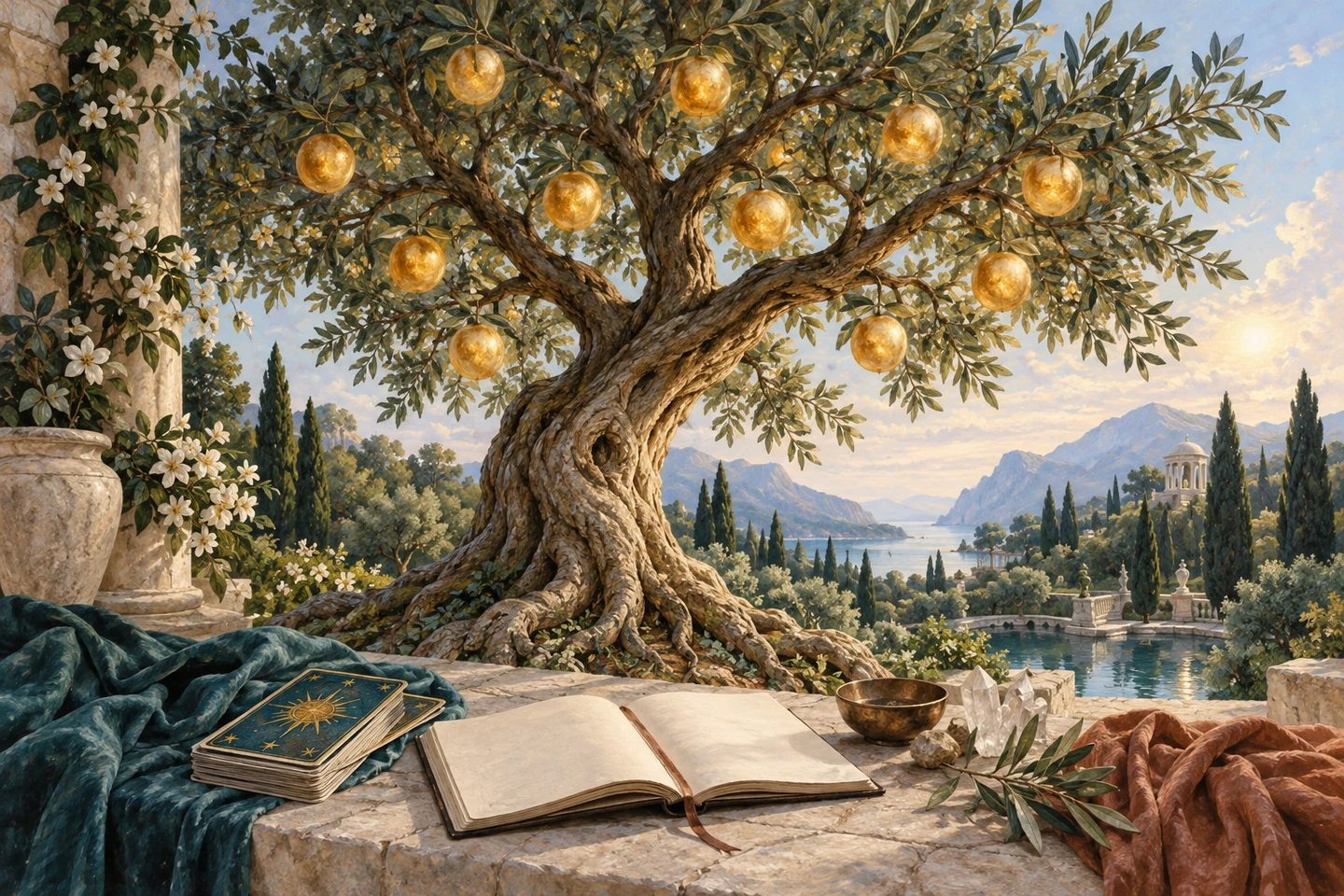
The Tree has ten sephiroth, often translated as spheres or emanations, connected by twenty-two paths in the common Hermetic diagram. The spheres describe stages or qualities of manifestation, from Kether, the Crown, to Malkuth, the Kingdom.
The vocabulary comes from Jewish Kabbalah. Hermetic tarot combines it with other Western esoteric teachings, including astrology and the four elements. The tarot assignments below describe that Hermetic use; they should not be taken as a complete account of Jewish Kabbalah or a rule followed by every tarot tradition.
Spellings vary in English: Tiphareth and Tiferet, for example, name the same sphere. The table uses spellings common in the reference books discussed here.
One suit at three points on the Tree
The Pentacles sequence lets you compare a root, the organisation of skill and a material result. All three cards belong to Earth, while their numbers occupy different spheres.
1: Kether
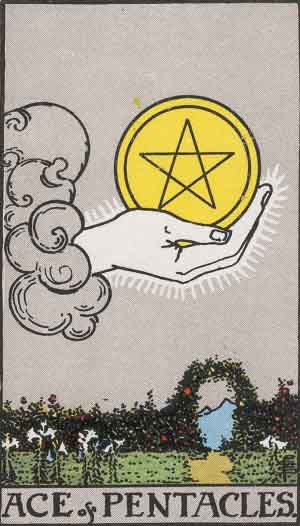
Ace of Pentacles
A material opportunity is present in its initial form.
8: Hod
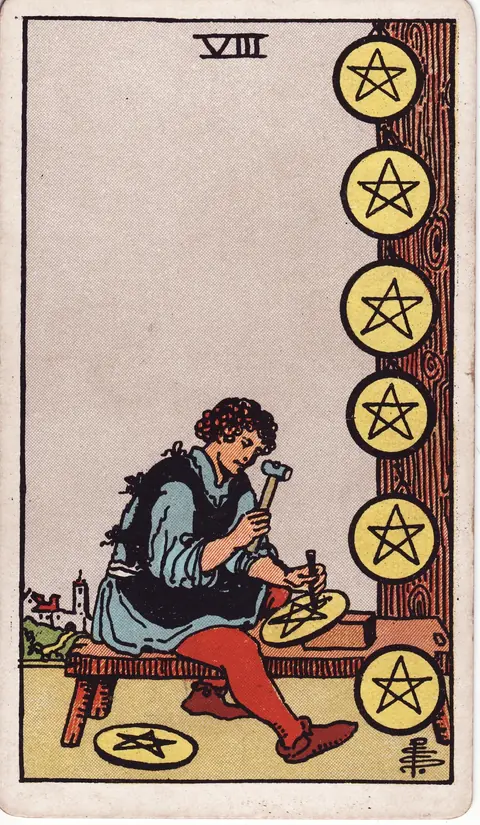
Eight of Pentacles
Practice gives skill a deliberate, organised expression.
10: Malkuth
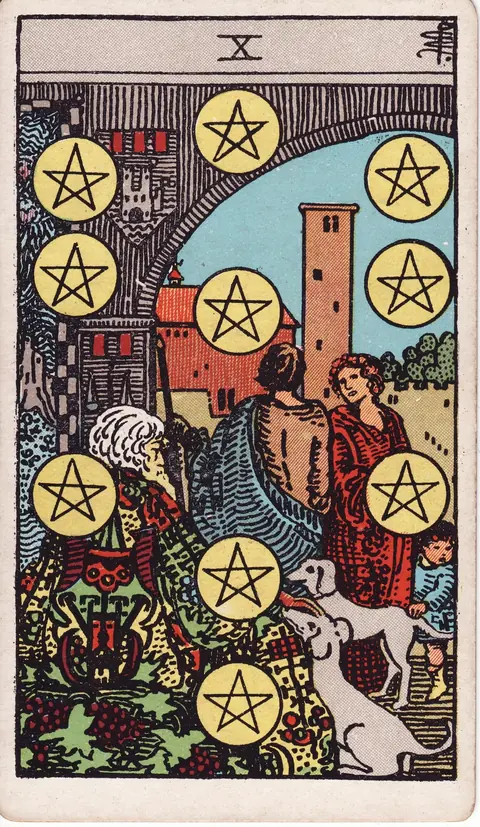
Ten of Pentacles
Resources have become established security or a lasting legacy.
Keep the stages distinct
The Ace describes a potential that still needs to be developed. The Eight shows the repeated work that gives a skill form. The Ten can describe resources established within a family or community. These are card comparisons, not a promise that every opportunity passes through all three stages.
Ten remains Malkuth in this study. Reducing it to One would belong to another numerological method. The full suit sequence is useful because it includes both welcomed results and the difficulties shown by other cards.
The ten numbers and spheres
Scroll sideways to read every column.
| Numbered cards | Sphere | Meaning of the name | A question for comparing the cards |
|---|---|---|---|
| Aces, 1 | Kether | Crown | What is present as a root or first potential? |
| Twos, 2 | Chokmah | Wisdom | How is the suit’s force beginning to act? |
| Threes, 3 | Binah | Understanding | What form has that force taken? |
| Fours, 4 | Chesed | Mercy | What order, support or stability holds it? |
| Fives, 5 | Geburah | Severity or strength | What tests, limits or disrupts it? |
| Sixes, 6 | Tiphareth | Beauty | How can its forces find a workable relationship? |
| Sevens, 7 | Netzach | Victory | What desire or feeling moves it? |
| Eights, 8 | Hod | Splendour | How is it organised, named or understood? |
| Nines, 9 | Yesod | Foundation | What pattern is ready to take a more definite form? |
| Tens, 10 | Malkuth | Kingdom | What has become a concrete result? |
The last column offers study questions, not translations or fixed predictions. A sphere has a much wider range of symbolism than one line can express. Start by understanding the card in front of you, then ask how the sphere clarifies it.
Daath, Knowledge, appears in some diagrams as an additional or hidden point. It does not create an eleventh numbered card in each suit in the arrangement used here.
Why Ten stays Ten here
In digit reduction, Ten can reduce to One. On the Tree, Ten belongs to Malkuth and One belongs to Kether. Reducing Ten to One would remove the distinction this system is trying to study.
The Ace of Pentacles presents a material opportunity in its initial form. The Ten of Pentacles can show resources established within a household, inheritance or lasting security. Both concern Earth, but they occupy different stages. A complete result may lead to another beginning without becoming identical to that beginning.
One number through four suits
The four Fours all relate to Chesed in this arrangement. Compare their scenes before treating Mercy as a promise that all four must feel comfortable.
The Four of Wands shows a supported occasion or achievement. The Four of Swords offers a protected pause. The Four of Pentacles secures material possessions, sometimes too tightly. The Four of Cups holds an emotional state that can become withdrawn or dissatisfied.
The number gives the cards a relationship through stability and containment. The suit and image explain what is contained and how that condition is being experienced. You would not read the Four of Cups as a celebration simply because the Four of Wands shares its sphere.
Numbers, planets and decans are different layers
Hermetic correspondences can give a card more than one planetary connection. The Eights belong to Hod, associated with Mercury in the Tree’s planetary arrangement. The Eight of Pentacles also belongs to the first decan of Virgo, ruled by the Sun in the Golden Dawn tarot scheme.
These labels answer different questions. Mercury belongs to the sphere shared by the four Eights. Sun in Virgo belongs to the specific astrological assignment of the Eight of Pentacles. They can be studied together without replacing one another.
For the Eight of Pentacles, you might compare the sphere’s concern with organisation and understanding with the card’s picture of repeated skilled work. The Sun-in-Virgo correspondence adds a focus on purposeful attention to detail. Read the decan guide for the complete numbered-card assignments.
The Majors belong to paths
In the common Golden Dawn arrangement, the twenty-two Majors correspond to the twenty-two connecting paths. The Magician’s printed I does not mean he is simply the sphere Kether. Major Arcana numbering and the Tree’s numbered paths are separate sequences.
The court cards have another set of assignments involving elemental ranks and the four worlds. They do not extend the Ace-to-Ten sequence as Eleven, Twelve, Thirteen and Fourteen in the method described here. Our court-card astrology guide explains why titles and elemental ranks need careful comparison between decks.
You can learn the sphere relationships first. Adding every path, letter, colour and world at once often makes it harder to see the actual card.
Worked comparison: the Fives and Sixes
Imagine asking, “How will this disagreement within our group develop over the next month?” Draw the Five of Wands for the present and the Six of Wands for likely development. Both are upright in this hypothetical example.
The Five describes competition or friction. The Six favours recognition and a more successful direction. Comparing Geburah and Tiphareth gives you an additional way to study the movement from a testing situation towards a more organised result.
The Six remains a forecast in its own position. Its sphere does not promise that every conflict automatically ends in success. If the second card were the Six of Swords, the development might involve leaving the difficult conditions instead. The shared Six would still matter, but the suit and scene would change the answer.
Build a small reference in your journal
Choose a number and lay out its four suit cards. Write the sphere’s name and translation, then describe what each scene actually shows. Add one upright and one reversed possibility for each card from its full meaning page.
Keep astrological notes in a separate column. That lets you distinguish a number’s sphere from an individual card’s planet and sign. When you use the correspondence in a reading, record what it helped you understand rather than copying the entire list into the answer.
Sources and further reading
Paul Foster Case’s The Oracle of the Tarot, especially Lesson 10 and its number discussions, uses the Tree’s numbers in divination. Robert Wang’s The Qabalistic Tarot explains the sephiroth, four worlds and tarot assignments in detail. Both are in our reference collection. The Golden Dawn’s Book T supplies the elemental and astrological card correspondences used alongside this framework.