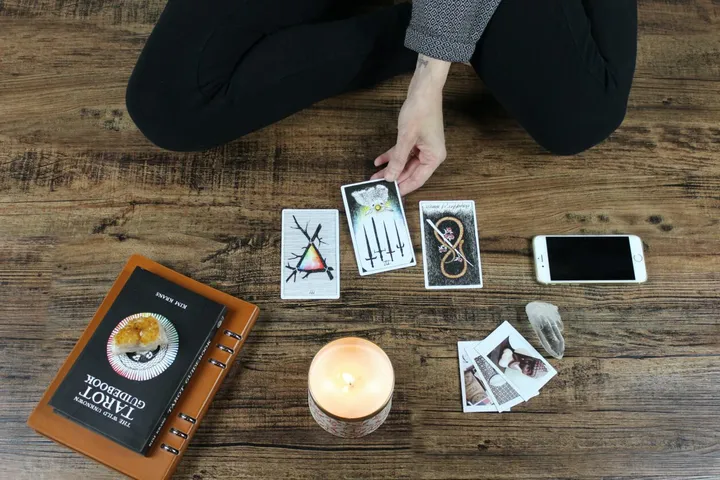
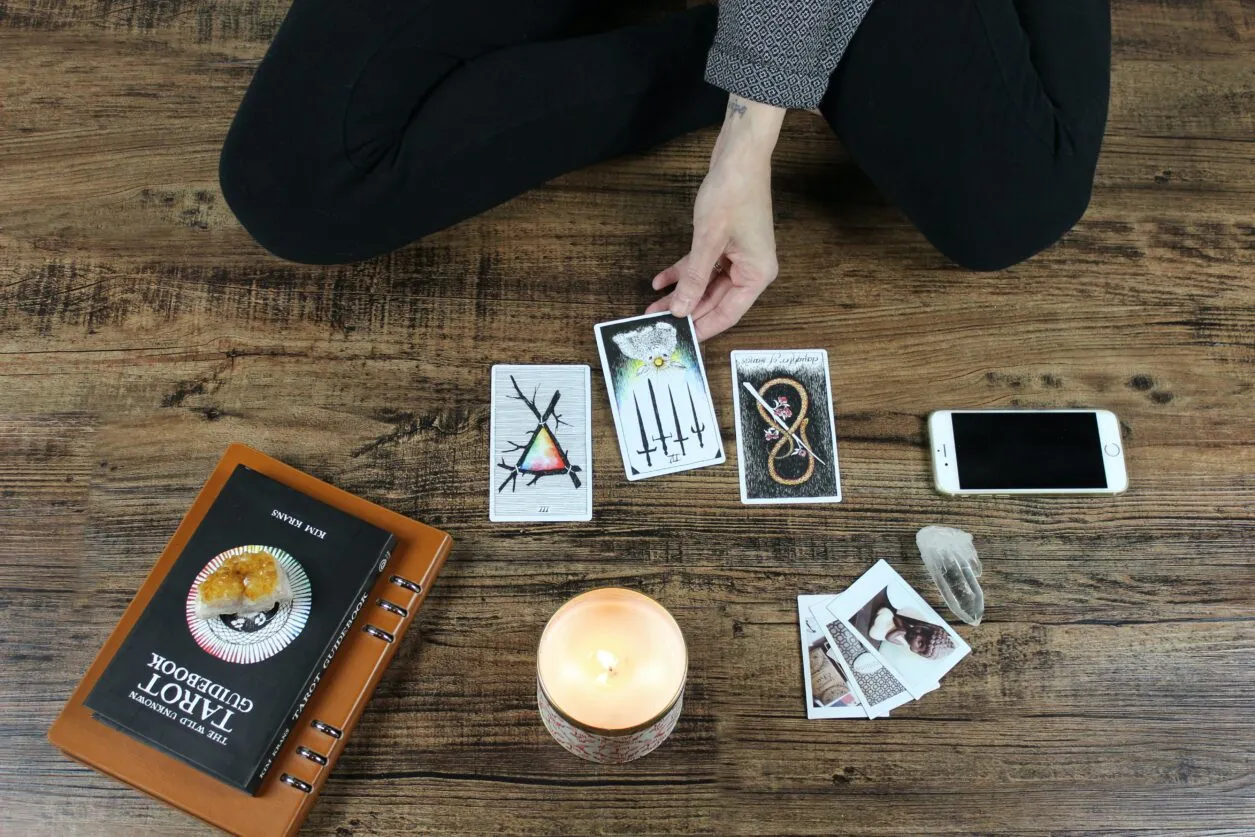
Numerology gives you another way to recognise connections between tarot cards. A number can suggest a theme such as beginnings, choice or completion. When the same number appears several times, that theme may become an emphasis of the reading.
The number belongs alongside the suit, picture and established card meaning. Four cards numbered Five share a connection, but the Five of Cups and Five of Wands describe different experiences. Reading both levels helps you see a pattern without flattening the individual messages.
Which cards have numbers?
Each suit of the Minor Arcana has an Ace and cards numbered Two through Ten. In a basic numerological reading, the Ace is treated as One. The Page, Knight, Queen and King are court ranks; this method does not assign them numbers. Some systems do, but those assignments need their own explanation.
The Major Arcana have a separate numbered sequence. In Rider-Waite-Smith, the Fool is Zero and the World is Twenty-One. The cards between them have their own titles, images and meanings. Read that sequence in our Fool’s Journey guide.
Deck traditions can number some Majors differently. Rider-Waite-Smith uses Strength at VIII and Justice at XI; the usual Marseille order places Justice at VIII and Strength at XI. Check the numbers printed on the deck you are using before drawing a numerological connection.
Number themes from Ace to Ten
These are common modern teaching themes, including those described by Brigit Esselmont. They are a starting point for interpretation rather than a single rule followed by every tarot tradition.
| Number | A useful theme |
|---|---|
| 1, the Aces | An opening; potential taking its first form. |
| 2 | Relationship, duality, balance or a choice. |
| 3 | Development, expression and involvement with others. |
| 4 | Structure, security and the limits of stability. |
| 5 | Disturbance, conflict or a difficult change. |
| 6 | Adjustment, exchange and movement toward harmony. |
| 7 | Assessment, testing and a considered response. |
| 8 | Sustained effort, movement or the use of power. |
| 9 | A situation approaching fulfilment or its limit. |
| 10 | The full result of a cycle and what follows it. |
An individual card can express the theme comfortably or reveal its difficulty. Eight is not automatically a forecast of success: the Eight of Swords can show restriction, while the Eight of Pentacles shows focused practice. Their pictures and established meanings matter more than a keyword applied to the number alone.
Compare the same number across the suits
Lay out the four Fours and look at what has become settled in each scene.
| Card | How the theme appears |
|---|---|
| Four of Wands | A stable place or shared achievement supports celebration. |
| Four of Cups | Emotional withdrawal can bring contemplation, but also dissatisfaction or a missed offer. |
| Four of Swords | A pause gives room for rest and recovery. |
| Four of Pentacles | Material security is held tightly and can become resistance to change. |
The shared number helps you ask what is stable or held in place. The suits tell you where to look, and the card scenes show how that condition is being experienced.
You can repeat this exercise with the Twos, Sevens or any numbered group. Write a sentence for each card before trying to sum up the group. That keeps the differences visible.
Read repeated numbers through their positions
Several Fives can make disruption prominent. Several Tens can draw attention to endings, fulfilment or commitments that have reached their limit. The cards show which of those possibilities fits and where it belongs.
Count the numbered cards, then read their positions. A Five describing the past shows a difficulty already experienced. A Five in an outcome position can forecast a challenge ahead. A Five as advice asks how to respond to that card’s experience. Repetition does not make those roles interchangeable.
Do not assign an exact number of days, weeks or people from a repeated number unless you have chosen a timing or counting method before the reading. Three Fives are not, by themselves, a universal code for fifteen days. The question’s timeframe still applies.
Worked example: three Fives during a change
Imagine asking, “What do I need to understand about this team change over the next month?” You choose current pressure, advice and likely development. All cards in this hypothetical reading are upright.
| Position | Card | Interpretation |
|---|---|---|
| Current pressure | Five of Wands | Competing views or unsettled roles are creating friction. |
| Advice | Five of Cups | Acknowledge what is being lost while recognising the support that remains. |
| Likely development | Five of Pentacles | A period of reduced resources or feeling excluded may follow; available help deserves attention. |
The three Fives make this a reading about difficulty during change. Wands locate the present pressure in competing energies. Cups bring attention to disappointment. Pentacles put practical support or material conditions in the forecast.
The answer is not simply “change is coming”. It identifies where the change is already uncomfortable, how to meet the emotional loss and what pressure may develop next. The Five of Pentacles belongs to the next month’s outlook; the Five of Cups gives advice now.
Digit reduction in the Major Arcana
One modern approach adds the digits of a Major Arcana number to find a smaller number. The Wheel of Fortune is Ten, so 1 + 0 gives One. The World is Twenty-One, so 2 + 1 gives Three.
Reduction can suggest a connection, but it does not make the cards identical. The Wheel still concerns turning conditions and cycles; the World still concerns completion and integration. Their full numbers and imagery remain part of the reading.
Use one reduction method consistently. In the method illustrated here, Eleven reduces to Two. Zero remains Zero; it is not added to the Ace group or treated as Ten.
A court card can repeat a suit or rank theme without repeating a number. For Pages, Knights, Queens and Kings, use rank and suit rather than inventing a numerical value midway through the reading.
Practise with one number group
Choose a number and put its four cards beside one another. Record a common theme, then note how each suit changes its expression. Include a difficult card in the comparison even if it complicates your first idea.
When that number next appears repeatedly in a spread, return to those notes. Record the actual positions and the resulting interpretation in your journal. Later, compare the pattern you expected with how the situation developed.
Further reading
Brigit Esselmont’s tarot and numerology introduction describes common number themes and digit reduction. A. E. Waite’s discussion of Strength explains its changed place in his deck. Our card-combinations guide places number patterns alongside other ways to connect cards.