
Kabbalah is a Jewish mystical tradition concerned with God, creation and the relationship between divine and human life. The word refers to receiving or a received tradition. Tarot books usually draw on a later Western esoteric development called Hermetic Qabalah, which connects the Tree of Life with tarot, astrology and other symbols.
If you have met words such as Kether, sephiroth or Atziluth in a card book and had no idea what they meant, start here. You do not need to know Hebrew or memorise a correspondence table to understand the basic framework.
Why Kabbalah appears in tarot books
The Tree of Life gives Hermetic tarot a way to organise relationships within the deck. It has ten numbered spheres and twenty-two connecting paths in the diagram commonly used by the Golden Dawn. The numbered Minor Arcana correspond to the spheres; the Major Arcana correspond to the paths.
That arrangement explains phrases such as “the Four of Pentacles is Chesed in Earth”. Four supplies the numbered sphere, Chesed. Pentacles supplies the suit’s Earth quality. You can understand the relationship gradually, after learning what a sphere and a suit mean.
The familiar Golden Dawn tarot assignments belong to Hermetic Qabalah. They are a later use of Kabbalistic ideas, rather than a tarot correspondence table found in the Torah. The Torah is Judaism’s foundational teaching, including the Five Books of Moses; Jewish Kabbalah studies its inner meanings within Jewish religious life.
A route into the subject
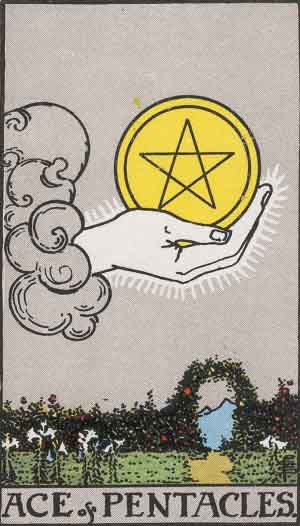
Start with the ideas and the diagram. The Ace of Pentacles is shown here as an example of a card you can return to once the basic terms are familiar.
- 1
Name the tradition
Recognise when a source is discussing Jewish Kabbalah or the Hermetic system used with tarot.
- 2
Recognise the diagram
Identify a sphere, a connecting path and the three pillars before adding card assignments.
- 3
Learn the fourfold pattern
Understand why a complete numbered sequence appears through each of the four suits.
- 4
Compare one card
Study its number and suit alongside the established meaning, then use its position in a reading.
Begin with one useful connection
The Ace of Pentacles can be studied as One, Kether, through Earth. Its familiar meaning of a practical opening remains the starting point. The correspondence gives you a relationship to compare with the other Aces.
You do not have to add every letter, colour or planet at the same time. A clear explanation of a sphere and suit gives you something you can use in your journal and return to when the card appears.
Kabbalah, Cabala and Qabalah
You will encounter several English spellings of the same Hebrew word. Writers often use them to signal the tradition they are discussing, but spelling alone cannot establish what a book teaches.
Jewish Kabbalah explores divine reality, creation and spiritual life within Judaism. Its study draws on Jewish texts and religious practice. The Zohar is an important collection of Kabbalistic teachings; the Sefer Yetzirah, or Book of Formation, is another foundational text discussed by later Kabbalists.
Christian Cabala developed through Christian readings of Jewish Kabbalistic material. Hermetic Qabalah developed within Western esotericism, combining Kabbalistic ideas with systems such as astrology, alchemy and tarot. The Golden Dawn, Dion Fortune, Paul Foster Case and Robert Wang belong to the Hermetic context discussed in these tarot lessons.
These traditions have different purposes and interpretations. A tarot book can be useful for studying Hermetic correspondences without being a guide to Jewish Kabbalah as a whole. Notice which tradition an author names before comparing two explanations.
The central idea: the infinite and its expression
Ein Sof, also written Ain Soph, means without end. It names the infinite divine reality beyond the limits of an ordinary description. Kabbalistic teaching uses the sephiroth to speak about divine expression and the relationship between that infinite source and the created world.
The word emanation describes a coming forth or expression from a source. In this context, the ten sephiroth express related divine qualities. They are not ten independent gods.
You may also meet the phrase divine light. It describes spiritual revelation or expression. The teaching is using light as a way to speak about divine reality, rather than identifying it with physical light measured by an instrument.
Hermetic writers develop these ideas through the Tree’s spheres, paths and correspondences. For a first reading, keep the broad relationship in mind: one source, different expressions, and connections between them.
A short glossary for reading a tarot book
- Tree of Life
- A diagram used to study relationships between the sephiroth. The common Hermetic version has ten circles and twenty-two connecting lines.
- Sephirah, or sefirah
- One sphere or emanation.
- Sephiroth, or sefirot
- The plural: the spheres or emanations considered together.
- Path
- A relationship or connection between spheres in the Hermetic diagram. The twenty-two connecting paths receive Major Arcana assignments.
- Correspondence
- An assigned symbolic relationship, such as linking the Fours with Chesed.
- Four worlds
- Four levels of manifestation: Atziluth, Briah, Yetzirah and Assiah. Each contains the tenfold pattern in the four-Tree approach used for tarot.
- Tetragrammaton
- The four-letter divine name, often written Yod-Heh-Vau-Heh in Hermetic books. Its four letters are related to the four worlds and elements.
The Tree of Life beginner’s guide shows the circles and connections in a labelled diagram. The four-worlds lesson explains the last two terms through the tarot suits.
Names are labels you can learn one at a time
Kether means Crown. Chesed is commonly translated as Mercy, and Geburah as Severity or Strength. Tiphareth means Beauty. These names identify parts of the Tree, much as the names of the tarot suits identify parts of the deck.
Their English translations are useful beginnings, but a sphere’s symbolism is wider than one word. Severity includes discipline and the ability to set a limit; it does not mean everything associated with Geburah is morally bad. Mercy can describe support and generosity, while an excess of expansion may still create a problem.
Spellings also vary. Keter and Kether, Gevurah and Geburah, Tiferet and Tiphareth can refer to the same named spheres. Use one reference consistently while you learn, and note alternate spellings when you meet them.
What the Tree can add to a card meaning
Take the Four of Pentacles. Its established meaning concerns material security and holding on to resources, sometimes too tightly. In the Hermetic number arrangement, its Four belongs to Chesed, the sphere associated with order and a supporting structure.
That gives you another way to examine the card’s stability. The suit tells you that the concern is material. The picture tells you how the security is held. Chesed supplies a wider relationship to the other Fours; it does not remove the possibility of possessiveness or resistance to change.
If the Four of Pentacles appears in a future position in a money reading, it can forecast a period of consolidation or a tendency to hold resources tightly. If it appears as advice, it may ask you to preserve what you have. The sphere helps you study the card; the question and position supply its role in the reading.
Begin with the diagram before the tables
Start with the Tree of Life diagram. Learn the difference between a circle and a connecting path, then locate one sphere whose tarot number you already recognise. Four is a useful beginning because you can compare all four Fours.
Next, study the four worlds and suits. This explains why a number can appear in Fire, Water, Air and Earth, and why each suit can be treated as a complete tenfold sequence.
Then use tarot and the Tree of Life for the full number-to-sphere table and worked card comparisons. You can add Hebrew letters, planetary symbols and path assignments later, once the underlying diagram is familiar.
For your first study session, write down one new term and explain it in an ordinary sentence. “Chesed is the sphere numbered Four, shared by the Fours in all four suits” is enough to make that term useful. Keep the explanation beside the cards in your tarot journal.
Sources and further reading
For the Jewish context, read Chabad’s brief definition of Kabbalah, introductory questions and explanation of the sefirot. The Sefer Yetzirah on Sefaria provides a primary text for further study; its concepts should be read in their own context before treating them as a modern tarot diagram.
Dion Fortune’s The Mystical Qabalah, particularly its introductory Tree chapters, explains the Hermetic framework. Robert Wang’s The Qabalistic Tarot distinguishes that framework from Jewish Kabbalah and applies it to the cards. Paul Foster Case’s An Introduction to the Study of the Tarot explains the suits, worlds and numbered spheres. The card example here is an instructional example developed for this guide.