
The four worlds are levels of manifestation in Kabbalistic teaching. Their names are Atziluth, Briah, Yetzirah and Assiah. In the Hermetic tarot arrangement used here, they are related to Wands, Cups, Swords and Pentacles respectively.
This helps explain why a complete sequence from Ace to Ten appears in every suit. Each suit expresses the tenfold pattern through a different world and element. If the names of the spheres are still unfamiliar, start with Kabbalah for tarot readers and the Tree of Life diagram.
What does a world mean?
A world describes a level or mode of existence. The teaching concerns how divine expression becomes creation and takes definite form. The names are often translated as Emanation, Creation, Formation and Action.
Hermetic books may also call them the Archetypal, Creative, Formative and Active worlds. These descriptions emphasise the passage from a spiritual pattern to a formed expression and material activity.
Pictures often place the worlds above one another to show that relationship. The worlds are understood as interrelated levels, rather than four ordinary places reached by travelling upward. Dion Fortune explains different conditions of existence as present together in a being; the diagram helps distinguish their relationships.
One sphere through four worlds
All four Aces belong to Kether in the four-Tree tarot arrangement. The suit changes the world and element through which that first potential is expressed.
Atziluth: Fire
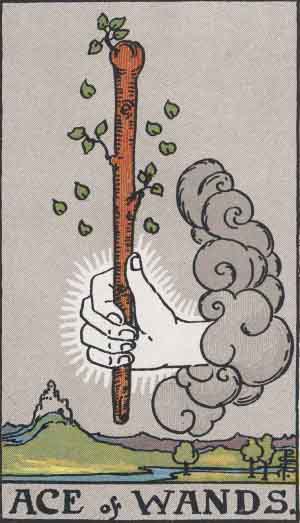
Ace of Wands
A creative impulse or opportunity to act.
Briah: Water
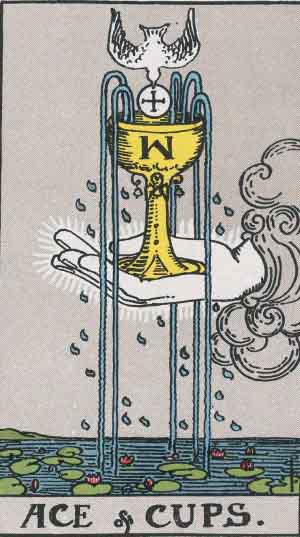
Ace of Cups
An emotional opening or new affection.
Yetzirah: Air
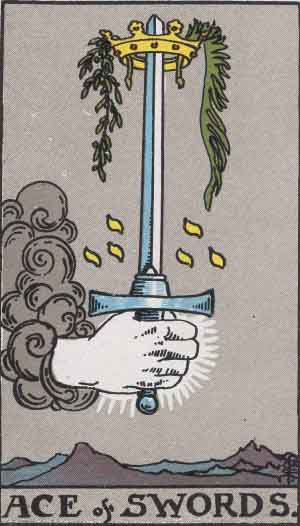
Ace of Swords
A new understanding, decision or clear statement.
Assiah: Earth
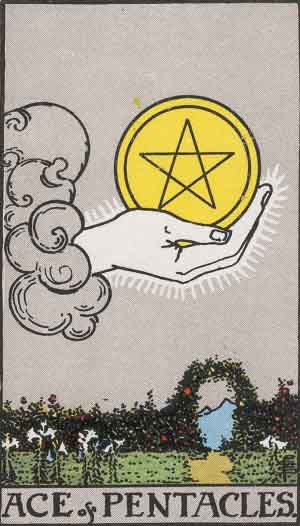
Ace of Pentacles
A practical opportunity or material resource.
The common number and different suits work together
The four Aces let you compare a root potential through Fire, Water, Air and Earth. The suit meanings make that comparison concrete, while the four worlds place it in the broader Hermetic framework. Their theological meanings extend beyond these short card descriptions.
In a reading, the positions determine what the openings mean for the question. An Ace as advice asks for a response; an Ace in a future position can forecast an approaching opportunity. The world assignment does not change those roles.
The four names and tarot assignments
This table follows the Hermetic tarot explanation in Paul Foster Case and Robert Wang. The suit and element assignments describe that tarot framework. They should not be treated as a claim that every Jewish explanation of the worlds uses tarot suits.
Scroll sideways to read every column.
| World | Common translation | Hermetic description | Tarot suit and element |
|---|---|---|---|
| Atziluth, also Atzilut | Emanation | Archetypal: the spiritual pattern or source. | Wands, Fire. |
| Briah, also Beriah | Creation | Creative: the pattern is expressed at a further level. | Cups, Water. |
| Yetzirah | Formation | Formative: patterns acquire a more defined form. | Swords, Air. |
| Assiah, also Assiyah | Action | Active: expression in material conditions and activity. | Pentacles, Earth. |
The alternate spellings are transliterations of the same Hebrew names. Atzilut in a Jewish introduction and Atziluth in a Hermetic tarot book need not name two separate worlds. Check the teaching as well as the spelling.
An ordinary analogy for the relationship
Imagine creating a small teaching garden. There is a guiding purpose for the undertaking, a fuller conception of what it could become, a plan that gives it a defined arrangement, and the practical work of planting and caring for it.
That sequence offers a way to think about pattern, creation, formation and action. It is an introductory analogy. The four worlds describe a much wider spiritual teaching than the stages of one gardening project.
The suit meanings give tarot a further set of study connections. Wands concern the creative impulse and will to act. Cups concern emotional experience and relationship. Swords concern thought, decisions and conflict. Pentacles concern resources, work and material circumstances.
Those practical tarot meanings do not exhaust the theological meaning of a world. Briah, for example, cannot be reduced to “having feelings” just because it corresponds to the Cups suit. Use the analogy to understand the arrangement, then retain the distinction between the world and its tarot expression.
Why every world has ten spheres
In the four-Tree approach used for this tarot study, the same ten sephiroth are present in each world. Each world therefore has a complete pattern from Kether to Malkuth.
The Ace of Wands belongs to Kether in Atziluth; the Ace of Cups to Kether in Briah; the Ace of Swords to Kether in Yetzirah; the Ace of Pentacles to Kether in Assiah. All four share the first sphere while expressing it through different suits and elements.
Likewise, the four Fours belong to Chesed in their respective worlds. The Four of Wands can show a stable occasion for celebration, while the Four of Pentacles concerns material security held tightly. The shared sphere gives a relationship; the suit, picture and full card meaning show its particular expression.
Ten numbers in each of four worlds give forty numbered suit cards, including the Aces. The astrological decan arrangement uses thirty-six cards because it begins with Two and runs through Ten. These are two different ways of organising the numbered cards.
Four worlds are different from four groups of spheres
Some books draw four complete Trees. Others show the worlds in relation to one Tree, with different levels emphasised in parts of the diagram. Robert Wang discusses both approaches.
For the numbered tarot suits, the four complete sequences are useful: Wands have their own Ace through Ten, as do Cups, Swords and Pentacles. Dividing the ten circles into four groups would not explain all forty numbered suit cards in the same way.
State which diagram or method you are studying before combining it with another. A four-Tree teaching and a single-Tree teaching can describe related ideas without assigning every detail identically.
The four letters of the divine name
Hermetic texts often relate the worlds to the Tetragrammaton, the four-letter divine name. In their English transliterations, the letters are Yod, Heh, Vau and a final Heh. Jewish sources may use Yud, Hei and Vav as spellings.
In the Hermetic sequence, Yod corresponds to Atziluth and Fire; the first Heh to Briah and Water; Vau to Yetzirah and Air; the final Heh to Assiah and Earth. The two occurrences of Heh have different positions in that sequence.
For this lesson, understanding what a book means by the four letters is enough. Court-card teaching also uses the fourfold elemental pattern, but rank titles vary between decks and authors. The court-card astrology guide explains that comparison before you assign a rank from a name alone.
Worked reading: a new teaching venture
Imagine asking, “What can I expect as I begin teaching over the next three months?” Choose four positions: motivating force, emotional connection, clarity needed and likely material opening. This hypothetical example uses four upright Aces.
Scroll sideways to read every column.
| Position | Card | Reading |
|---|---|---|
| Motivating force | Ace of Wands | A creative impulse gives the venture its energy and an opening to begin. |
| Emotional connection | Ace of Cups | A new connection or warm emotional response can support the work. |
| Clarity needed | Ace of Swords | Define what you are offering and make the necessary decisions clearly. |
| Likely material opening | Ace of Pentacles | The outlook favours a practical opportunity, resource or paid opening within the question’s timeframe. |
The four Aces let you compare Kether through the four suits. The spread’s positions give those potentials different roles. Only the Ace of Pentacles in the final position supplies this particular forecast of a material opening.
An actual reading may contain different numbers, courts and Majors. You do not need to force them into an Ace sequence or draw one card from every suit. The four worlds are a study framework that adds to the meanings of the cards actually drawn.
Continue with one repeated number
Choose a number and lay out its four cards. Use the number-to-sphere table to identify the shared sphere. Then write how each suit changes its expression.
For the Fours, note the difference between celebration, withdrawal, rest and holding resources. For the Tens, compare emotional fulfilment with accumulated responsibility and difficult endings. These comparisons make the four-world arrangement useful while keeping the full card messages visible.
Sources and further reading
Paul Foster Case’s An Introduction to the Study of the Tarot directly assigns Wands to Atziluth, Cups to Briah, Swords to Yetzirah and Pentacles to Assiah. Robert Wang’s The Qabalistic Tarot, in its discussion of the four worlds, explains their levels, letters, elements and four-Tree tarot application. Dion Fortune’s The Mystical Qabalah discusses the ten sephiroth in the four worlds and the distinction between symbolic levels and physical places.
Chabad’s Jewish introduction to the four worlds gives the religious context of the names and levels. The suit comparisons, garden analogy and hypothetical tarot reading here are teaching examples for the stated Hermetic method.