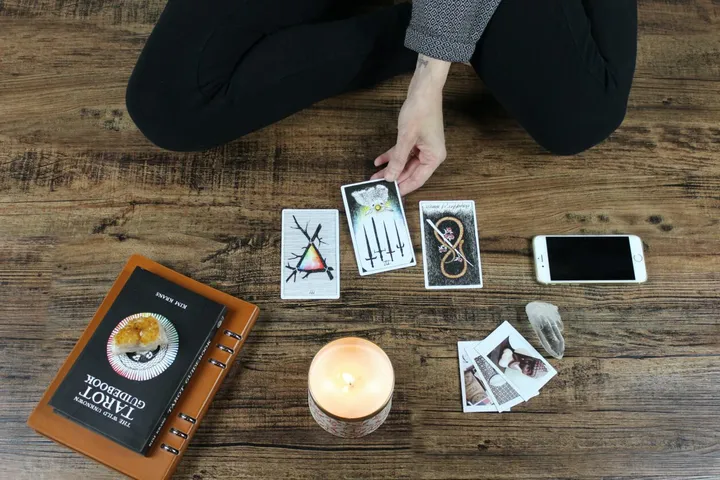
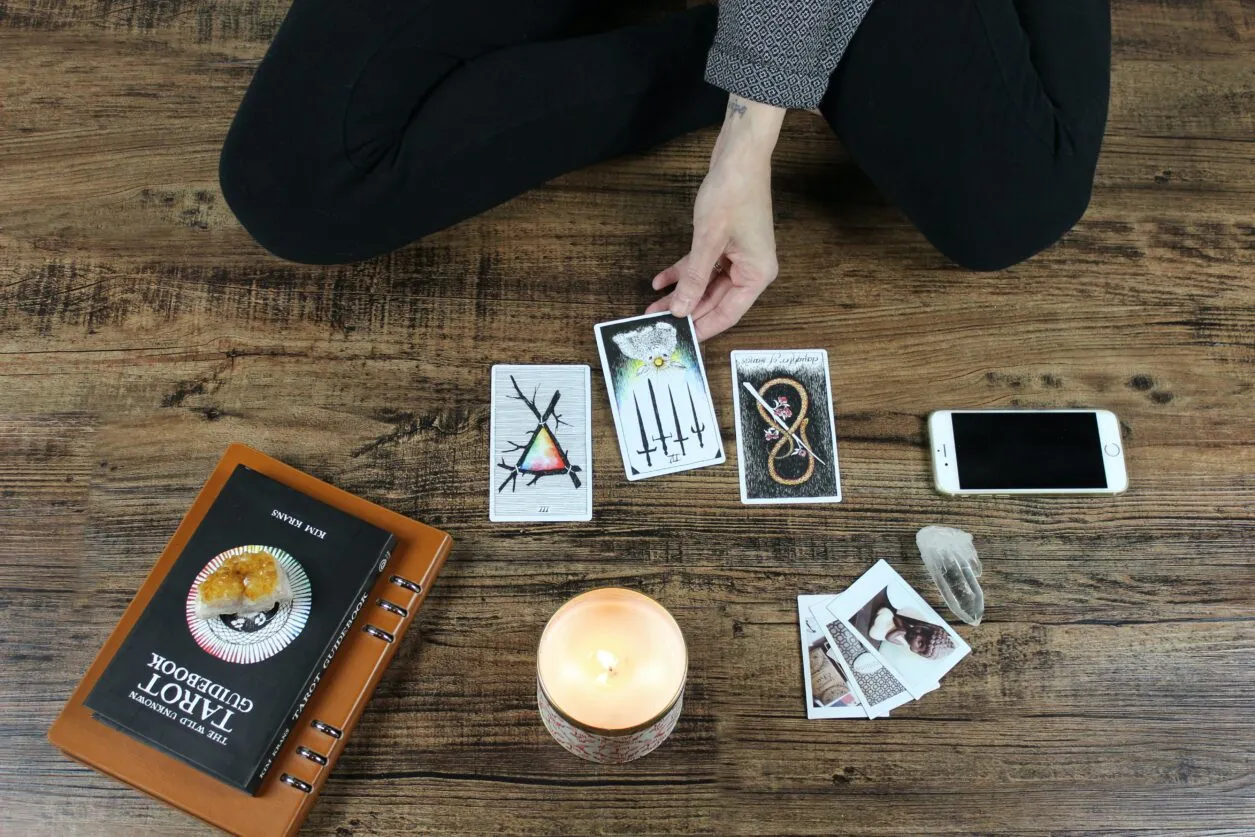
A tarot card combination is the meaning that emerges when you read two or more cards in relation to one another. One card may describe a situation and another its development, advice or complication. Their connection depends on the question, positions and orientations as well as the individual card meanings.
Learning those relationships makes a reading more coherent. Instead of giving a separate description of every card, you can explain how the cards contribute to the same message.
Start with the question and positions
Name the central theme of each card, using the card meanings library when you need to check it. Then apply that meaning to its position. A card about an opportunity works differently in “what is approaching?” than in “what am I overlooking?”
For example, the Ace of Pentacles and Three of Pentacles share practical themes. In a work reading, they can connect a new opening with skilled collaboration. In “situation and advice”, the Ace may describe the opening while the Three recommends working with people whose expertise supports it.
In “past and future”, the same cards could describe an earlier opportunity developing into cooperation. The relationship between the cards comes from the positions you chose before drawing.
Look for reinforcement and contrast
Some cards bring the same theme into stronger focus. Others show different needs or directions within the situation. Joan Bunning teaches both opposing and reinforcing pairs. These ideas help you notice how the cards interact in a particular reading.
| Pair | Shared theme or contrast | An interpretation in context |
|---|---|---|
| Three of Cups and Four of Wands | Celebration and shared happiness. | In a social reading, a gathering or milestone may bring people together. |
| Eight of Pentacles and Three of Pentacles | Skilled work, alone and with others. | A career reading may show personal practice becoming a valued contribution to a team. |
| Four of Swords and Eight of Wands | Rest alongside rapid movement. | In challenge and advice positions, the reading may ask how you can respond to fast developments without losing needed recovery time. |
| The Moon and The Sun | Uncertainty alongside clarity. | In a past-to-future sequence, confusion may be giving way to a clearer understanding. |
These are possible readings of the pairs. A different question or reversed orientation changes how you connect them.
For the Moon and Sun, order is especially helpful. Moon first and Sun later can suggest growing clarity. Sun in the past and Moon in the future can indicate that a previously clear situation is becoming harder to read. Keep the order attached to the spread’s actual time positions.
Notice patterns across the whole spread
Repeated suits tell you which concerns have emphasis. Several Pentacles may focus the reading on work, resources or practical arrangements. Several Cups can draw attention to emotional ties. A missing suit can be interesting, but a small spread will often omit one or more suits simply because it contains few cards.
Repeated numbers give another connection to examine. You may notice a recurring stage or tension across different suits, while the pictures show how each card expresses it. Use this alongside the individual meanings rather than replacing them with a numerical rule.
Several Major Arcana cards often draw attention to larger themes, choices or transitions. Court cards may bring people or attitudes into those developments. Their presence does not automatically mean that every court represents a different person; our court-card guide explains the alternatives.
Follow the pictures without turning every detail into a rule
Notice what the figures are doing and where your eye moves between the cards. Does one image appear to approach another? Does a still scene sit beside a hurried one? Does a repeated object support a theme you have already found?
These observations can help your intuition connect the cards. They need to fit the deck in front of you: another artist may position a figure differently. Treat an apparent gaze as a visual clue and check it against the question, positions and card meanings.
Worked example: a practical opening taking shape
Imagine asking, “How is this work opportunity developing, and what will help me respond?” You use a situation, challenge and advice spread and draw three upright cards.
| Position | Card | Meaning in the reading |
|---|---|---|
| Situation | Ace of Pentacles | A tangible opening is beginning to take shape. |
| Challenge | Two of Pentacles | Existing responsibilities make it difficult to give the opening enough attention. |
| Advice | Three of Pentacles | Bring the work into a clear, collaborative arrangement. |
All three cards are Pentacles, so practical conditions deserve attention. The Ace introduces the opportunity; the Two shows the competing demands; the Three points toward shared skill and coordination.
Taken together, the reading suggests that the opening can develop through cooperation, provided you make enough room for it. A useful next step is to clarify responsibilities and who can contribute. The sequence from Ace to Three supports development, but the spread’s last position is advice, not a guaranteed outcome.
Include reversals in the connection
If one card is reversed, consider how its altered expression changes the relationship. Suppose the Eight of Pentacles is upright beside the Six of Wands reversed in a career reading. The Eight supports effort and skill; the reversed Six may show that recognition is delayed, absent or less satisfying than hoped.
The combined message might be that work is progressing while acknowledgement lags behind. You would read it differently from two upright cards suggesting skill followed by recognition. Check whether the positions describe cause and result, the present and future, or advice and a challenge before settling the relationship.
Our reversals guide explains how blocked expression, delay and other methods can help you narrow the reading.
Practise building a short account
Draw two cards for an imagined question and give each a position. Write one sentence about each card, then a sentence connecting them. Include the specific relationship you see: one supports the other, complicates it, follows from it or offers a response.
Change the positions and read the pair again. An outcome card moved into hopes and fears becomes an expectation to examine. This exercise helps you see why a combination list can only offer starting points.
For actual readings, keep the question and orientations in your journal. Record the interpretation before events unfold, then return to it to see which connection proved useful and which needs reconsideration.
Further reading
Read Joan Bunning on card pairs and position pairs, and Brigit Esselmont’s guide to card combinations for different ways to develop connections between cards.