
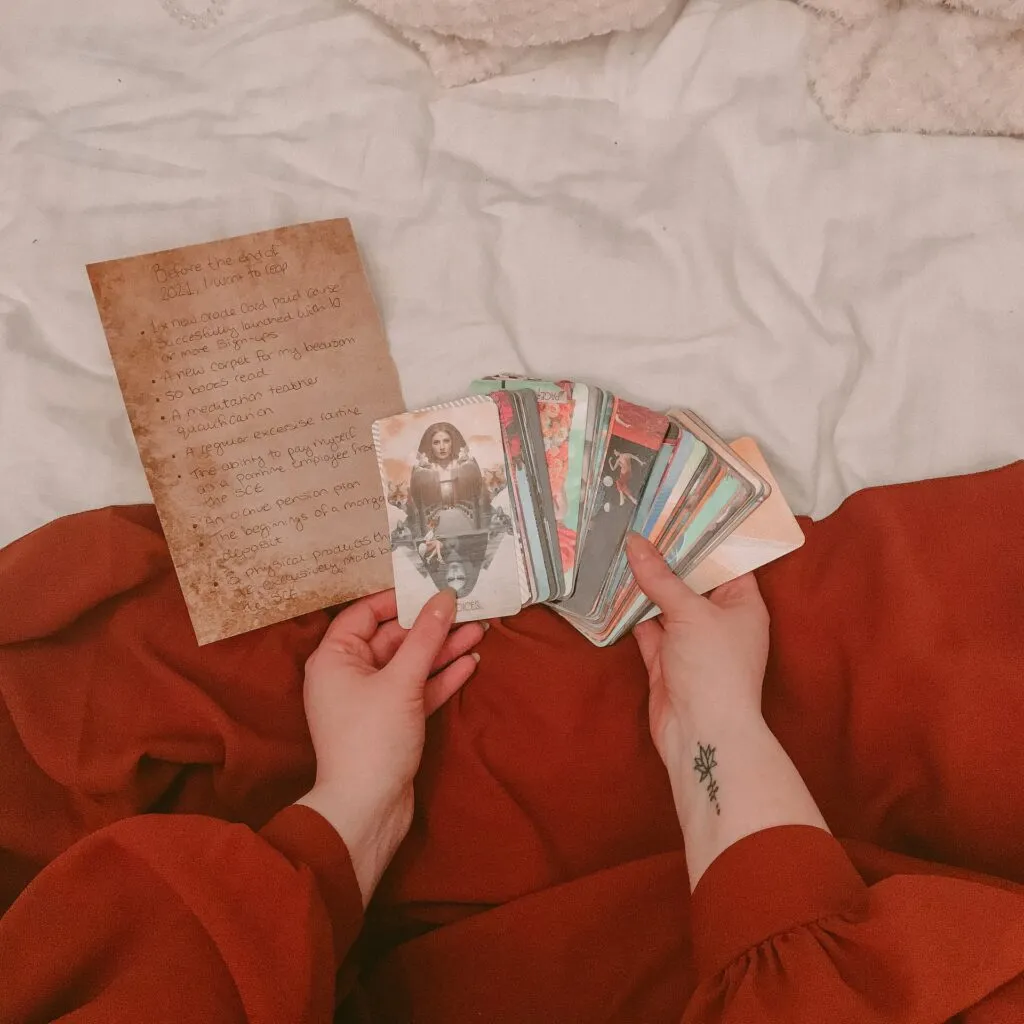
A reversed tarot card appears upside down relative to the direction you have chosen for reading. Its orientation adds information about how the card’s meaning is working in the situation. That might be an obstacle, a delay, a private experience or a change in the strength of its usual qualities.
Reversals have several established approaches. You can learn the reversed meaning of each card, or use a consistent method to examine how the upright theme changes. Many readers combine both, guided by the question and the rest of the spread.
Decide how you will use reversals
Reading reversals is a choice. Some readers work entirely with upright cards and recognise difficulties through the question, positions and neighbouring cards. Others use orientation as an additional part of the message. Both approaches are used in tarot practice.
Decide before shuffling, including whether the cards will face you or the person receiving the reading. If a reversed card appears during a reading you intended to keep upright, turn it upright and continue with that method.
To introduce reversals, you can divide the deck, rotate one portion by 180 degrees, put it back and shuffle. Turn drawn cards over from side to side, like a page, to preserve the top-to-bottom orientation. Turning them end over end changes it.
In a Celtic Cross, note the second card’s original orientation before laying it sideways. The crossing position alone does not make a card reversed.
Start with the card’s upright meaning
Before interpreting the reversal, identify the card’s central subject. The Eight of Wands concerns movement and rapid developments. The Four of Swords concerns a pause, rest and recovery. Their reversals still belong to those themes, even when the way they are expressed changes.
Use the 78-card meanings library to check both orientations. A specific reversed interpretation may be more useful than applying the same general rule to every card.
Traditional meanings are not always simple opposites. Waite’s reversed Sun retains the card’s favourable character with its strength reduced, for example. The relationship between upright and reversed meanings varies from card to card.
Several ways to interpret a reversal
These approaches are alternatives you can consider. They are not a sequence you must apply in full to every reversed card.
| Approach | What it asks you to notice | Example |
|---|---|---|
| Traditional reversed meaning | The particular meaning given for this card in the tradition or deck you use. | The Sun reversed can show happiness or success that is reduced or harder to enjoy. |
| Blocked expression | The card’s qualities are present but have difficulty coming through. | Six of Wands reversed can show an achievement receiving too little recognition. |
| Delay | The development associated with the card is slowed or interrupted. | Eight of Wands reversed can indicate messages or plans taking longer than expected. |
| Inward expression | The theme is being experienced privately or within the person. | Strength reversed can show the private work of recovering confidence when self-doubt is difficult to express. |
| Excess or shortage | A quality has become disproportionate, or there is too little of it. | Eight of Pentacles reversed may show careless work or perfectionism that prevents completion. |
| Release or recovery | A difficult pattern is easing, or the reading concerns the effort to move beyond it. | Ten of Swords reversed can point to recovery after an ending, though it may also show resistance to accepting that ending. |
Joan Bunning describes reversals in terms of energy that has not fully developed or become available. Brigit Esselmont also teaches inward expression, imbalance and blockage as ways to read them. These are established modern methods. Tarot traditions differ in how they use reversals.
Let the position and surrounding cards narrow the meaning
Suppose the Four of Swords reversed appears. Read in an obstacle position after a period of intense work, it may warn of exhaustion and difficulty resting. In a near-future position after a long pause, it may predict a return to activity. The reversal has several possibilities; the question, position and other cards help you choose between them.
Consider the whole pattern before selecting the interpretation you prefer. If several cards concern overwork, the exhaustion meaning has support. If they point to renewed movement and opportunity, readiness to return may fit better.
Intuition belongs in this process, too. Notice the image or thought that catches your attention, then check how it connects with the spread. You can leave an uncertain meaning open in your notes instead of forcing every card into a settled answer.
Worked example: an opportunity that is moving slowly
Imagine asking, “How is my application developing over the next month?” in a situation, challenge and advice spread. You draw the Ace of Pentacles upright, Eight of Wands reversed and Eight of Pentacles upright.
The Ace of Pentacles describes a practical opening. The reversed Eight of Wands, in the challenge position, suggests slower communication or delayed progress. The Eight of Pentacles as advice favours careful preparation and attention to the quality of your work.
Together, the cards can indicate a real opportunity whose pace is frustratingly slow. The reading advises using that period to strengthen your preparation. It does not turn the Ace’s opening into a definite job offer, and the delayed movement does not by itself say that the application has failed.
This example uses the delay method because the position concerns an obstacle and the upright cards support an opportunity that needs work. In a different question, the same reversed Eight might describe scattered effort or a rushed approach.
Avoid making every reversal mean the same thing
A reversed card does not automatically mean “no”, deception or a bad event. Some readers choose an upright/reversed yes-or-no system, but that is a declared reading convention. It is not a universal meaning of orientation.
The reverse is also true: you do not need to soften every difficult card into reassurance. A reversal can warn of imbalance, a missed opportunity or a development that is unlikely to proceed as hoped. Read what the spread supports, including its less comfortable possibilities.
A high proportion of reversals may invite you to examine blocked progress or unresolved conditions if that fits your method. It does not independently establish that every area of life is going wrong. Identify which themes repeat and where they appear.
Practise with one card and one method
Choose a card and write its upright theme in your tarot journal. Then write a reversed interpretation using one of the approaches above. Name a hypothetical question and position so the meaning has a context.
For instance, consider the Eight of Pentacles reversed as advice about completing a project. Excess might point to endless polishing; shortage might point to insufficient care. What would you expect to see in the other cards if each interpretation were appropriate?
Return to actual readings after events develop. Record whether the reversal described a delay, an inward experience or another expression. Over time, those observations will help you choose a method with more confidence.
Further reading
Read Joan Bunning’s lesson on reversed cards, Brigit Esselmont’s approaches to reversals and Waite’s Major Arcana divinatory meanings to compare the methods and their different emphases.