Keywords
Upright: Isolation, self-imposed restraint, confinement, feeling powerless.
Reversed: New perspectives, release, liberation, overcoming fear.
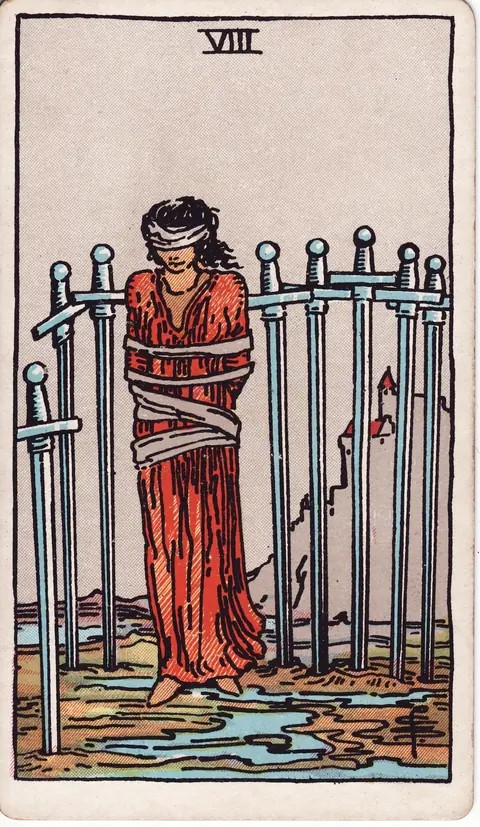
Read the image
The blindfold
The blindfold can indicate a narrow view or an inability to see events clearly. It can also suggest impartiality and refusing to be deceived by appearances.
The bonds
The bindings suggest immobility, shame, and difficulty acting. They can also indicate loyalty to duty or a deliberate period of inward attention.
Mind and body
The bound figure links thought with action. Mental restraint affects how freely the body can move, while steadfastness can hold you to a chosen commitment.
Overview
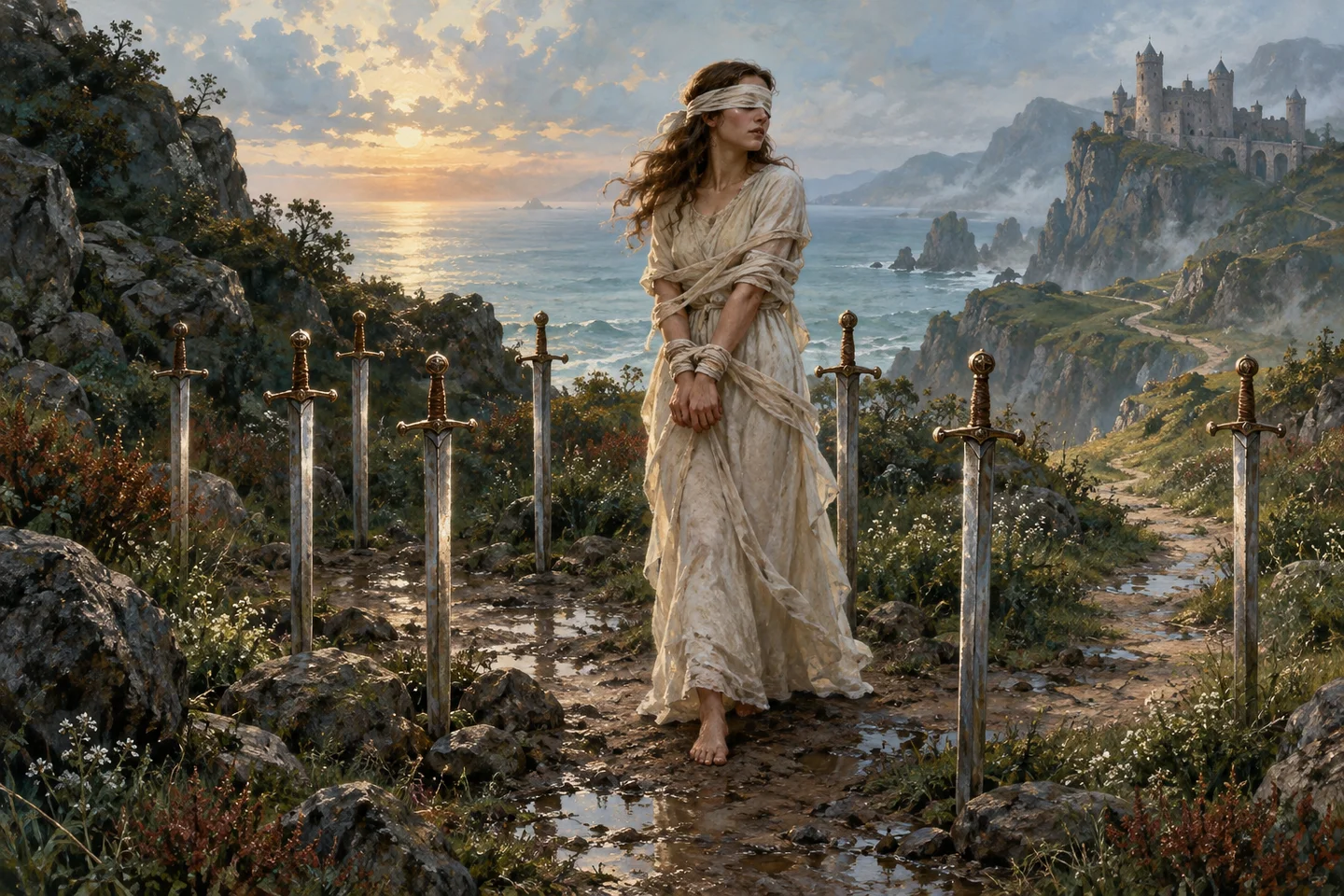
The Eight of Swords describes feeling lost, bewildered, and powerless. The woman is blindfolded and bound, far from the castle that might offer safety. Help seems distant, and she cannot see how to reach it.
The card can appear around an unsatisfying job, an unstable relationship, or debts that seem impossible to manage. It can also describe unease when life appears satisfactory from the outside. The central difficulty is a sense that you have no choice. Yet the image contains openings, and the reading asks you to recognize where freedom remains possible.
A Closer Look at the Eight of Swords
Description
A woman stands bound and blindfolded among eight swords. The ground is wet and barren, the sky gray, and a distant settlement lies beyond her immediate reach. The scene conveys isolation and despair.
The swords do not make an unbroken barrier. There is an opening in front of her, but the blindfold prevents her from seeing it. Her thoughts about the situation have become part of the confinement. The same swords that surround her also suggest tools capable of helping her cut the bonds.
Meaning
The Eight of Swords indicates restriction, boundaries, and frustration. Its archetype is the Victim, its astrological association is Jupiter in Gemini, and its Kabbalistic association is Hod, Glory. This difficult pause can still become a time to rethink your strategy and identify another route.
Upright
Upright, the Eight of Swords extends the stillness of the Four into a stronger sense of imprisonment. The restriction may be real, but fear and fixed beliefs can make it appear more complete than it is.
Reach out and accept help that is offered. The card warns that the farther you enter a restrictive situation, the harder it can feel to leave. Recognizing available choices is the first movement toward freedom, even before you are ready to act on them.
Reversed
Reversed, the card foretells liberation from an earlier constraint. Reflection has revealed an answer, and concerns that once formed a cage no longer carry the same power. A new degree of self-awareness brings acceptance, peace, and room to move.
In a more difficult spread, the reversal can show fear becoming more entrenched instead. The surrounding cards help distinguish a release from a deepening sense of oppression.
The Symbolism of the Eight of Swords
- The blindfold: The blindfold can indicate a narrow view or an inability to see events clearly. It can also suggest impartiality and refusing to be deceived by appearances.
- The bonds: The bindings suggest immobility, shame, and difficulty acting. They can also indicate loyalty to duty or a deliberate period of inward attention.
- Mind and body: The bound figure links thought with action. Mental restraint affects how freely the body can move, while steadfastness can hold you to a chosen commitment.
- The mountain: The hill suggests obstacles and the perspective gained by understanding your own depths. Letting go creates room to rise.
- The castle: The distant castle can mean isolation or enclosure, but also safety, independence, and a secure sense of self.
- Water and earth: Mud can suggest drained emotions and unmet needs. Water and earth also bring attention to the basic conditions that sustain life.
- The encircling swords: The instruments of confinement can become tools of release. Your intellect offers strength and protection when you use it differently.
- The red clothing: Red represents lifeblood and willpower. The surrounding swords may suppress those energies or provide the structure that supports them.
- The gray sky: Gray can convey composure, neutrality, and focused awareness. Its shadow is a hostile atmosphere, apathy, or refusal to participate.
Eight of Swords as Feelings
In a question about someone's feelings, Eight of Swords can describe feeling unable to act on the bond. Its orientation and position help explain how that emotional pattern is expressed.
Upright feelings
Feeling unable to act on the bond
The Eight of Swords can indicate fear, restriction or a sense of powerlessness around the connection. Someone may care while believing they have too few choices to express it. Their view of what is possible can be narrower than the situation itself.
Reversed feelings
A new emotional perspective
Reversed, the person may begin to recognise a choice, release fear or find a way out of the restriction. Feelings become easier to handle when they no longer seem trapped within one conclusion. The reading can show where that freedom is emerging.
A hypothetical relationship reading
In a feelings position, the Eight can describe someone who wants change but feels unable to act. A separate obstacle card helps explain what constrains them and what may allow release.
Read these feelings through the question and the card's position. The full love and relationship interpretations below explain how the same emotional pattern can affect a connection.
What the Eight of Swords Means in a Reading
In a reading about feeling unable to change jobs, the upright Eight of Swords asks which limits are real and which options you have not yet been able to see. Reversed, it may predict anxiety easing and a route opening, or warn that the sense of oppression is deepening.
The Devil explores the hold of an attachment. The Eight emphasises the experience of confinement, while the Nine of Swords concentrates on the worry that can surround it.
Meaning for Love and Relationships
Upright
The Eight of Swords indicates fears and expectations obstructing love. If you are single, a rigid picture of the ideal partner may leave little room for an actual person. You cannot control every part of falling in love.
In a relationship, the card can show feeling trapped. Express your feelings honestly and respond to what your partner actually says, rather than what you hope or fear they mean. Start with the choices, words, and assumptions you can change.
Reversed
Reversed, the card can predict relationship anxiety easing and barriers being overcome. If you have felt imprisoned in a harmful or abusive relationship, it can foretell a way out.
Its darker meaning is oppression increasing, including a partner’s controlling behavior becoming more extreme. Supporting cards clarify which direction events are taking.
For someone single, the reversal can show confidence returning after fear has blocked love. It can also indicate dating anxiety becoming so severe that connection feels impossible. Support and a new perspective help open the way.
Meaning for Career
Upright
You may feel trapped in a job you dislike, while more options exist than you currently recognize. The Eight of Swords asks you to look beyond the paths you have already labeled reasonable or practical.
Speak with people who have changed careers or followed a route that interests you. Your personal and professional networks may introduce someone whose experience helps. You do not need to make an immediate move; first discover what else is possible.
Reversed
Reversed, this card can indicate work anxiety easing, or leaving a role that limited your potential. The workday becomes easier once fear releases its grip.
It can also forecast an already stressful job becoming more oppressive. If the situation is making you miserable, consider the available routes out rather than assume you must remain indefinitely.
Meaning for Health and Well-Being
Upright
The Eight of Swords can describe feeling betrayed by your body through illness or aging. Fear and helplessness may narrow your sense of what improvement is possible.
Question those limiting beliefs while continuing the care your condition needs. What if a change in routine felt manageable, or someone could help? The card asks you to allow room for support and possibility rather than regard your present experience as the only future available.
Reversed
Reversed, the Eight of Swords can foretell recovery from anxiety, PTSD, agoraphobia, depression, or panic attacks. It can also indicate successful treatment of an eye problem.
In a difficult spread, it points instead to deep depression and a frightening belief that there is no way out. If you are thinking about suicide, seek immediate support from a mental health professional, emergency service, or someone you trust. Help and other possibilities remain available.
Meaning for Finances
Upright
The Eight of Swords questions the belief that every goal must wait until you have more money. That assumption can hide other ways of making progress, even when the financial limits are real.
Look for options beyond the one route you have already decided is necessary. The card asks where fear or habit has made your circumstances feel less flexible than they are.
Reversed
Reversed, the card can indicate financial worries easing and a clearer, more confident approach to money. Alternatively, unease may have become more entrenched. If your finances are stable, building a rainy-day fund can help replace a vague fear with a practical sense of security.
Eight of Swords and Other Cards
A neighbouring card can emphasise, complicate or change the direction of a reading. Compare what each card contributes before deciding how they connect.
Eight of Swords
Isolation, self-imposed restraint, confinement
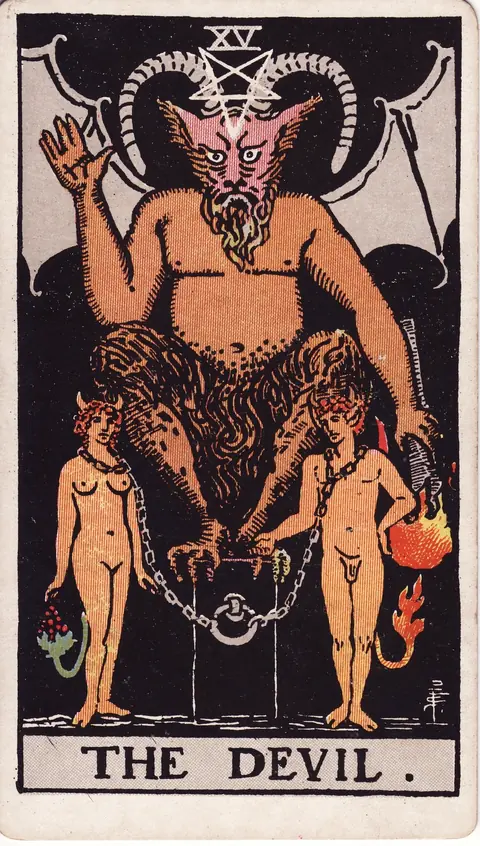
The question gives the pair its context
Eight of Swords brings isolation, self-imposed restraint, confinement into the reading. The Devil adds attachment, dependency, compulsion. In a spread, identify which card describes the situation and which describes a response, influence or outcome.
If either card is reversed, compare its reversed interpretation too. A reversal can alter whether a quality is available, obstructed or expressed in a difficult way. The meanings are connected through the question rather than simply added together.
Practise those connections with How to Read Tarot Card Combinations and a three-card spread.
Timing
The Eight of Swords foretells an important idea turning inward to solve a problem. This can happen within the next few hours or days. A new understanding reveals an opening that was previously difficult to see.
Dates associated with this card include May 21 to May 31.
Yes or No Questions
The Eight of Swords answers no. It indicates obstacles, severe challenges, fear of failure, or an unfavorable turn of luck. Restriction currently dominates the situation.
The no need not mean permanent confinement. The card asks you to recognize available help and choices, because the opening may be closer than your present view allows you to see.
Number and astrological correspondence
Jupiter in Gemini belongs to this restrictive card in the Golden Dawn system. The planet’s name alone does not turn the scene into a promise of freedom. Its Golden Dawn assignment is Jupiter in Gemini, covering the first decan: 0 degrees up to, but not including, 10 degrees of that sign.
In the separate Tree of Life number system, the 8 belongs to Hod, Splendour, shared by all four cards of this number. That comparison can bring attention to organisation and understanding, while the suit and scene explain this card’s particular expression.
The decan assignment comes from the Golden Dawn’s Book T. Use the complete tarot decan table to compare its neighbouring cards, or our numerology guide to compare the same number across the suits. A drawn card’s assignment does not establish a current planetary transit or an automatic calendar date.