
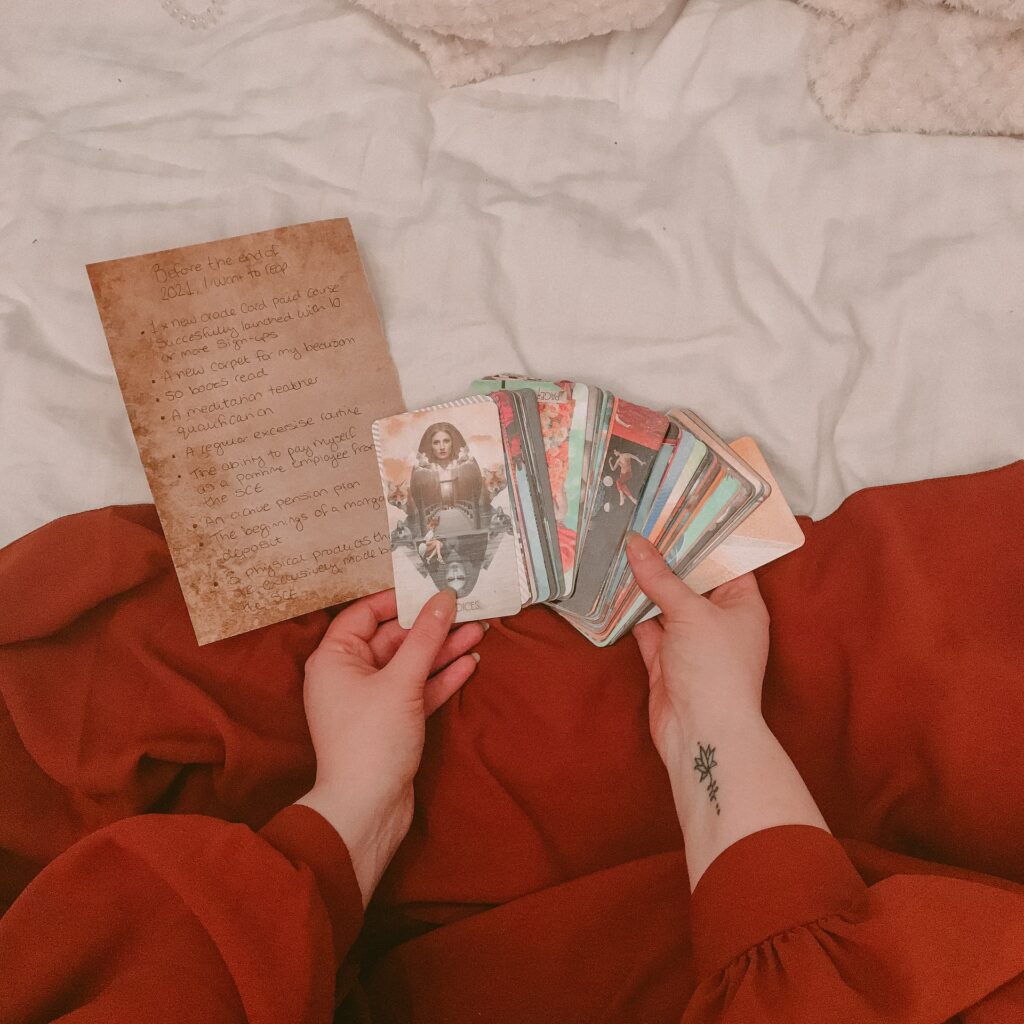
A question helps you connect the cards with the situation you want to understand. Take a little time to consider what is happening, who is involved and what you hope to learn from the reading.
Write down a few thoughts before choosing the wording. You may find that the question changes as you become clearer about the issue. A question that seemed to concern someone else’s behavior may become a question about how you want to respond.
Ask for insight into your choices
Keep responsibility for your decision with yourself. Ask for information that will help you consider it. An open question gives you room to explore influences, possible actions and what those actions might mean.
For example, “Should I change jobs?” can become “What do I need to understand about changing jobs?” You can then read each card in relation to the concerns and opportunities around that choice.
Questions beginning with “What do I need to know about…”, “How can I…” or “What might happen if…” offer different ways into a reading. Choose the wording that fits what you actually want to explore.
Leave room for more than one answer
Check whether your question assumes that you have already found the only solution. “How do I get this person to agree with me?” limits the reading to obtaining agreement. “What can I understand about our disagreement?” leaves room to consider both perspectives.
You can still ask about a specific course of action. “What might a move into sales mean for me?” gives the reading a clear subject while leaving the interpretation open.
After writing your question, read it once and notice any answer you are already expecting. Record that expectation in your journal so you can return to it when reviewing the cards.
Find a useful level of detail
A very broad question can be difficult to interpret. A question that is too narrow may focus on a small detail while missing what troubles you.
| Starting question | A more focused question |
|---|---|
| How can I improve my work life? | What can I understand about communication with my colleague? |
| Will this relationship work? | What do I need to know about the current direction of this relationship? |
| Why does nothing go right? | What can I learn from the difficulty I am facing now? |
Include enough context to identify the issue, then give yourself room to consider what the cards suggest.
Keep yourself in the reading
When reading for yourself, consider your part in the situation. You can ask how someone else’s actions affect you, what you need to understand, or how you might respond.
“What do I need to know about this relationship?” is a question you can connect with your own experience. A reading about another person’s private thoughts is harder to check against what you actually know.
If you are reading with someone else, agree on the question together. Make sure both of you understand its meaning before choosing a spread.
Check the tone of the question
Notice wording that assumes blame or defeat. “Why am I the only person doing the work?” carries a conclusion into the reading. “How can we share the work more fairly?” gives you a situation and a possible direction to examine.
Aim for wording that allows you to consider something you have not already decided. You can acknowledge a difficult feeling without making it the only possible interpretation of every card.
Choose a spread that fits
Use a one-card spread when you want to focus on one aspect of a question. For a situation with several parts, a three-card spread can separate the situation, opportunity and challenge.
Write the question above your reading notes. When you interpret a card, connect it with that question and its position. Returning to the wording can help when you have several possible meanings and need to decide which fits the reading.