
Keywords
Upright: Regretful but necessary transition, rite of passage, moving toward peace.
Reversed: Difficulty moving on, emotional baggage, delays, disruption.
Overview
The Six of Swords describes the subdued period when you are surviving rather than thriving. The people in the boat seem withdrawn and sad. There may be no immediate crisis, yet the pleasure has drained out of ordinary life.
It also foretells a positive turn after difficulty or psychological shock. The numbness is beginning to lift, and you are putting life back together. The passengers are already moving toward another shore, even if they cannot yet welcome it. You are on your way to better circumstances before you fully feel their promise.
A Closer Look at the Six of Swords
Description
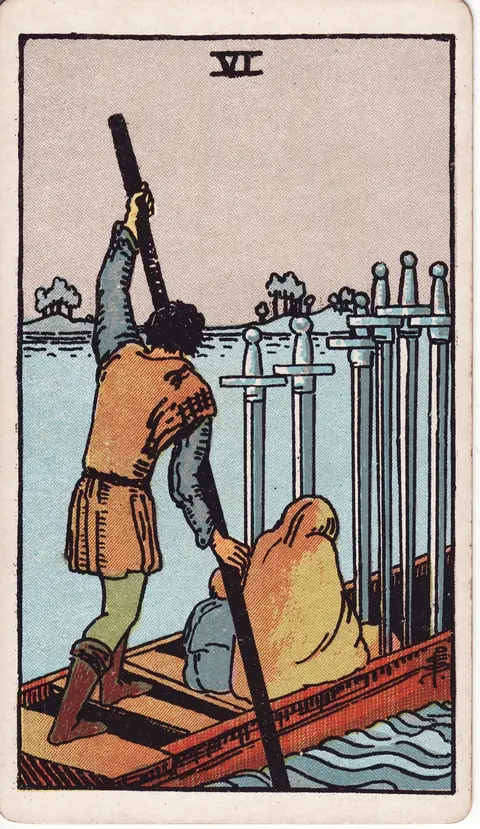
A ferryman rows a woman and small child across the water. The woman’s covered head suggests sadness or loss as she leaves something behind. Six upright swords stand in the boat, bringing the rational mind along on the journey.
The water beside the boat is rougher than the calm stretch ahead. The departure is sorrowful, but the destination offers peace. Reason is helping the travelers move away from conflict even while their hearts remain attached to the past.
Meaning
The Six of Swords indicates a gradual change in perspective and circumstances. Its archetype is Loss, its astrological association is Mercury in Aquarius, and its Kabbalistic association is Tiphareth, Beauty. The harmony of Six appears here as relief after conflict.
Upright
Upright, the card predicts a period of reflection and reassessment after a difficult struggle. You can see earlier confrontations from a new angle, revise your plans, and find enough distance to think again.
It often indicates travel, relocation, or a change of surroundings. The journey can also take place inwardly, as you move from one state of consciousness to another. Joy may take time to return, but the direction is favorable. New and more positive circumstances are approaching.
Reversed
Reversed, the Six of Swords indicates that problems leave you little time to think. One issue leads to another, and plans suffer delays, disruption, or unwanted interference.
You may resist leaving the past or carry old assumptions into every new situation. Decisions require care because an attempted escape can create another complication. The journey is obstructed rather than completed, and the baggage needs attention before you can move freely.
The Symbolism of the Six of Swords
- The shared boat: The travelers inhabit the same situation but play different roles. The boat also suggests consciousness moving across the waters of the subconscious.
- The ferryman: The ferryman is a mediator, recalling the figure in Hermann Hesse’s Siddhartha. His shadow is restlessness or homelessness, as in the Brothers Grimm’s The Devil with the Three Golden Hairs.
- The active figure: The person guiding the boat represents responsibility and deliberate action. The danger is deciding for others or becoming fixed in your own judgment.
- The seated woman: She represents patience and openness to events. Her shadow is indecision, feeling inadequate, or surrendering every choice to someone else.
- The child: The child brings curiosity and openness to unfamiliar experience, alongside dependency and the possibility of unwelcome surprises.
- The pole: Progress comes through contact with the ground. The pole suggests thoroughness and a return to basics, while its dark color can point to hidden motives.
- The six swords: The swords can be experience used as a compass, or prejudices carried forward until they obstruct the view.
- The backward view: Seeing the figures from behind invites attention to their less conscious intentions. It can also suggest turning away from oneself.
- The two waters: Rough and calm water show the transition between old and new circumstances. Change requires movement across them.
- Blue and gray: These colors suggest calm, objectivity, and a clear mind. Their shadow is indifference, repetition, or muddled thinking.
What the Six of Swords Means in a Reading
Meaning for Love and Relationships
Upright
The Six of Swords usually predicts recovery after a breakup. Fresh love requires a clean break from the past and a willingness to step into unfamiliar territory. The future holds more promise than you can presently see.
In a committed relationship, you and your partner have the chance to make a fresh start. Forgiveness and leaving old grievances behind will allow you to build something stronger. The passage toward a calmer relationship has begun.
Reversed
Reversed, the card indicates a rough patch in which you feel trapped, overwhelmed, or unable to move the relationship forward. A third party may be interfering. If you are planning to marry, it can predict an elopement.
For a single person, progress may stall while the wounds of a past relationship heal. Give the recovery time. Entering another connection before you have dealt with the previous one can repeat the difficulty in a new form.
Meaning for Career
Upright
A difficult but necessary change is coming. Losing a job or an important customer can feel devastating, but the Six of Swords indicates that it prepares you for something better. The setback will not define your career indefinitely.
If work feels like a dead end, another route to your goal is opening. Advice from someone outside your field can help you recognize it. Make room for work that interests you by letting go of what no longer belongs in your professional life.
Reversed
Expect disruption at work. Someone may be creating problems, or you may feel trapped in a job you dislike. Plans can be amended or canceled, and projects delayed. A business trip abroad may also face obstacles or cancellation. The reversal asks for care before making a hurried move out of frustration.
Meaning for Health and Well-Being
Upright
The Six of Swords can indicate low spirits or the blues: life feels flat, and you are getting through it without much enjoyment. It also predicts the beginning of improvement after a difficult period.
Seeing the situation clearly will help you commit to the next step. The card brings hope, but asks you to participate in the recovery rather than wait for everything to change around you.
Reversed
Reversed, the card predicts recovery from illness or injury taking longer than expected. Setbacks and delays can leave you feeling in limbo. The uncertainty will pass. Seek balance and allow healing the time it needs rather than treating a slower recovery as permanent failure.
Meaning for Finances
Upright
The Six of Swords can indicate expenses connected with a move, relocation, or short holiday. It also asks you to accept your current financial position and forgive earlier mistakes.
You cannot undo the past, but practical steps now will change what follows. Take responsibility for everyday choices and pay attention to smaller amounts as well as the larger commitments.
Reversed
Reversed, the card indicates an attempt to avoid financial problems. You may feel unable to face them, but postponing attention keeps you stuck. Careful effort and competent advice will help you regain control and move toward a more stable position.
Timing
The Six of Swords foretells an important idea turning inward and then outward to resolve a problem. The event can unfold within the next few hours or days, beginning a transition toward calmer circumstances.
Dates associated with this card include January 30 to February 8.
Yes or No Questions
The Six of Swords answers yes. It predicts a brighter future, relief, or a period of peace. The route may require clear thinking and a willingness to leave familiar circumstances behind, but the eventual outcome is beneficial.
Travel or relocation may be involved. Even when the movement is inward, the card shows you leaving a difficult place and approaching something better.