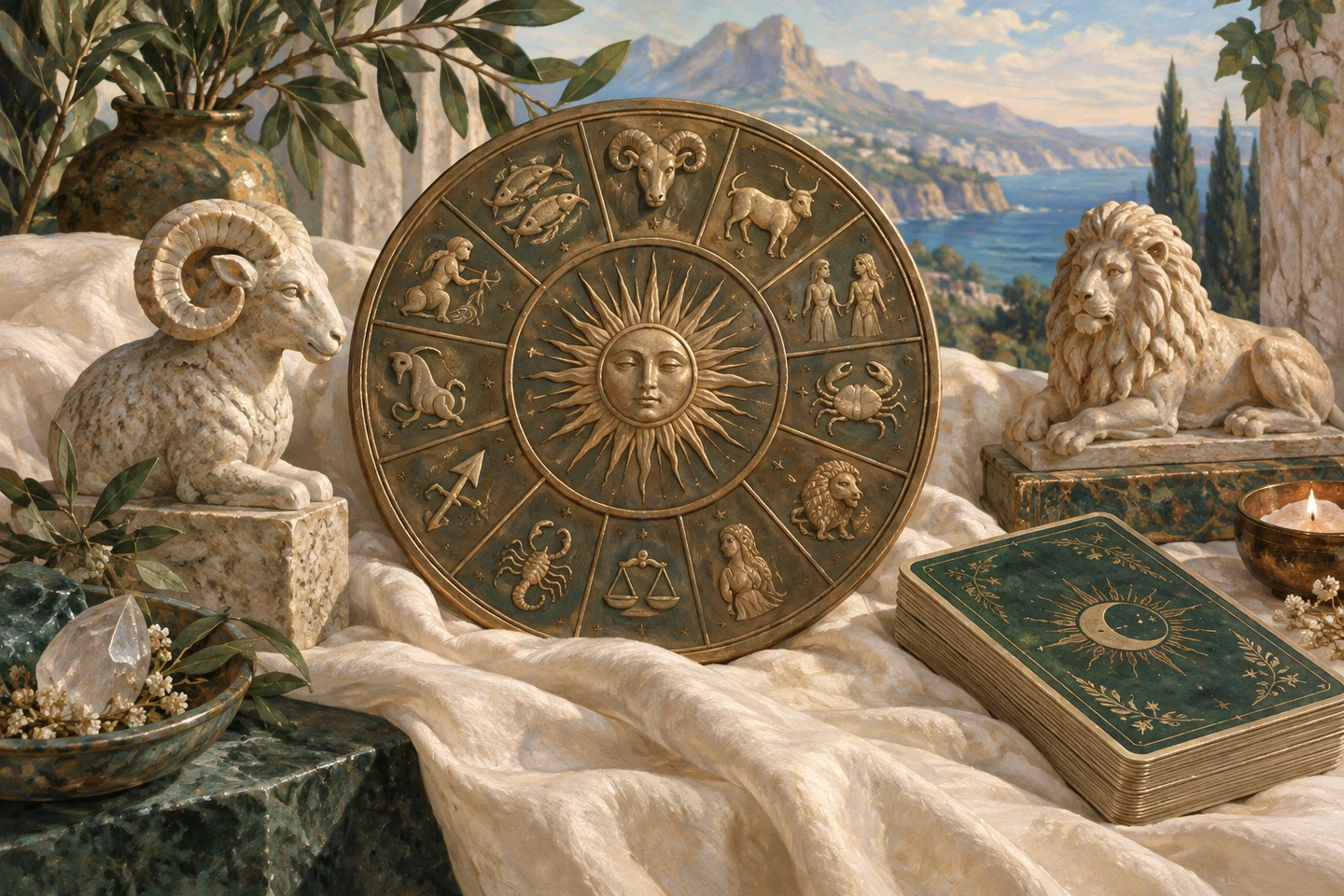
Each of the twelve zodiac signs has a Major Arcana correspondence in the Golden Dawn tarot system. Aries belongs to the Emperor, Leo to Strength and Pisces to the Moon. These connections help explain card symbolism and give you another way to compare cards in a spread.
A sign’s card can be used for study or as a chosen significator, but it does not describe everything about everyone born under that sign. A drawn Emperor can represent authority or initiative without identifying an Aries person. The reading’s question and position decide which use is relevant.
The twelve signs and their cards
This table follows Book T, with Rider-Waite-Smith titles. The element and mode belong to the zodiac sign. They add context to the card’s own meaning.
Scroll sideways to read every column.
| Zodiac sign | Major Arcana | Element | Mode |
|---|---|---|---|
| Aries | Emperor | Fire | Cardinal |
| Taurus | Hierophant | Earth | Fixed |
| Gemini | Lovers | Air | Mutable |
| Cancer | Chariot | Water | Cardinal |
| Leo | Strength | Fire | Fixed |
| Virgo | Hermit | Earth | Mutable |
| Libra | Justice | Air | Cardinal |
| Scorpio | Death | Water | Fixed |
| Sagittarius | Temperance | Fire | Mutable |
| Capricorn | Devil | Earth | Cardinal |
| Aquarius | Star | Air | Fixed |
| Pisces | Moon | Water | Mutable |
A difficult card does not condemn its sign. Death’s Scorpio association concerns transformation and endings. The Devil’s Capricorn association can help examine ambition, material conditions and attachment. People with those Sun signs have an entire birth chart and a life beyond one tarot correspondence.
Three different ways to handle Fire
The Emperor, Strength and Temperance share Fire-sign correspondences. Their modes and individual meanings help you distinguish initiating, sustaining and adapting.
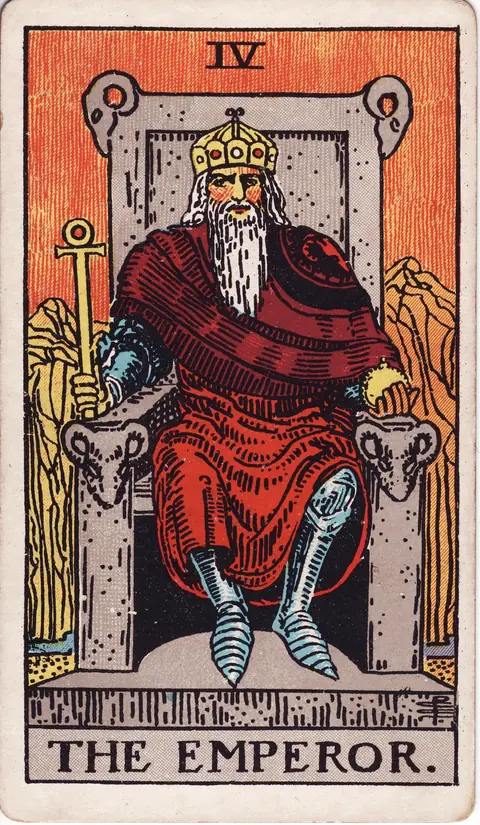
Aries: cardinal Fire
The Emperor
Set a direction and establish the necessary boundaries.
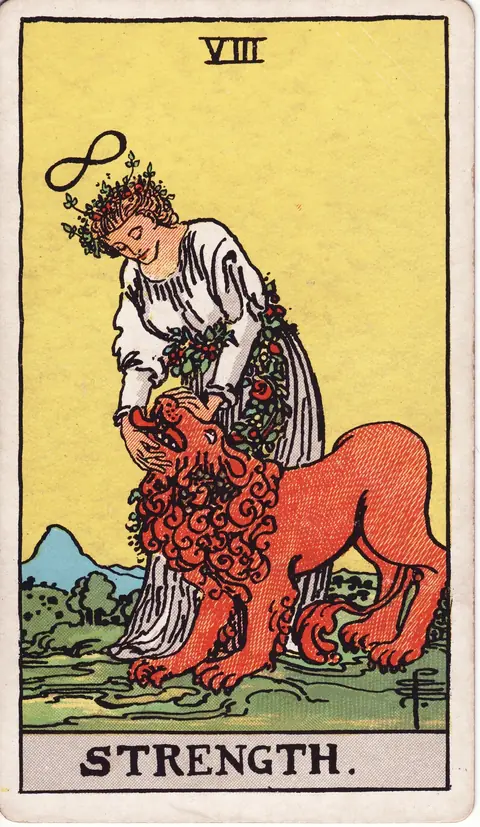
Leo: fixed Fire
Strength
Sustain courage while handling powerful feelings with composure.
Sagittarius: mutable Fire
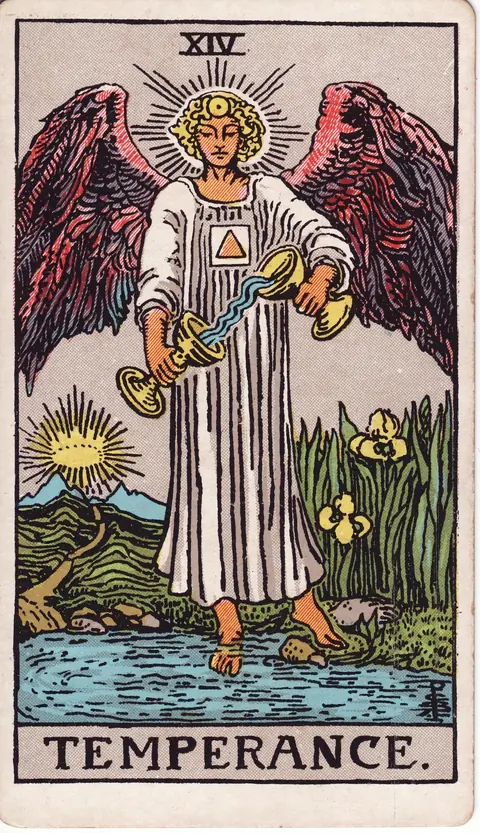
Temperance
Adjust the mixture and find a workable relationship between influences.
Read the difference in the response
The Emperor can ask for a clear decision. Strength can favour patience with a difficult feeling. Temperance can support negotiation and adjustment. Their shared Fire does not make the advice identical.
Modes add a study question to the full card meaning. They do not automatically establish speed, a calendar date or a person with a particular Sun sign. Use the question and position to decide what each card contributes.
Compare the three Fire signs
The Emperor, Strength and Temperance all have Fire-sign correspondences, but they handle force differently.
Aries is cardinal Fire. The Emperor establishes a direction and a structure. Leo is fixed Fire. Strength sustains courage and meets the lion’s power with composure. Sagittarius is mutable Fire. Temperance works through adjustment and the integration of different influences.
In advice positions, these cards can suggest different responses. The Emperor may call for a clear decision and boundaries. Strength may ask for patience while you handle a strong feeling. Temperance may favour negotiation or a workable mixture. Calling all three “be confident” would miss the useful distinctions.
Earth, Air and Water comparisons
The Earth-sign Majors are the Hierophant, Hermit and Devil. Their meanings let you study the difference between an established teaching, careful individual discernment and a material attachment that has become restrictive. Earth does not make every one of these cards an uncomplicated prediction of wealth.
The Air-sign Majors are the Lovers, Justice and Star. Compare an important choice, the judgement of consequences and a renewed view of the future. Their shared element can connect a reading while each card gives the thought or decision a different role.
The Water-sign Majors are the Chariot, Death and Moon. You might compare how someone directs themselves through emotional pressure, passes through an ending or faces uncertain impressions. Water includes resolve and difficult change as well as sensitivity.
These comparisons are study approaches. Use the full card meanings to choose the expression that fits your actual spread.
What cardinal, fixed and mutable mean here
The modes describe different ways a zodiac sign’s element operates. Cardinal signs initiate; fixed signs sustain; mutable signs adapt. Used with tarot, they give you questions to test against the image rather than a replacement set of meanings.
With the cardinal cards, ask what is being started or directed. With fixed cards, ask what is held, sustained or difficult to shift. With mutable cards, ask what needs adjustment or a different response.
This is not a timetable that makes every cardinal card fast and every fixed card slow. Death can announce a decisive ending despite its fixed-sign correspondence. The picture, full meaning and position still determine the reading.
The sign and its ruling planet are separate
Libra is associated with Justice and traditionally ruled by Venus. Venus is directly assigned to the Empress in the Major Arcana correspondence table. Justice and Empress therefore have a connection through Libra’s ruler, while remaining different cards.
Likewise, Taurus belongs to the Hierophant and is ruled by Venus. You can compare the Hierophant’s values and continuity with the Empress’s attraction and growth. You would not replace one with the other when reading a spread.
Our tarot and astrology overview includes the full planetary and elemental assignments. It also explains why the Moon card belongs to Pisces while the High Priestess has the direct Moon correspondence.
Worked example: three kinds of Fire
Imagine asking, “How should I guide this creative project towards its next stage?” Choose the current need, the way to meet the challenge and likely development. In this hypothetical upright reading, draw the Emperor, Strength and Temperance.
The Emperor in the first position asks for a defined direction: decide what the project is meant to achieve and who has responsibility. Strength as the response favours steady handling of tension rather than trying to overpower everyone involved. Temperance in likely development suggests a workable integration of different contributions.
Their Aries, Leo and Sagittarius correspondences add a shared Fire theme, expressed through initiating, sustaining and adapting. They support the reading’s structure without changing advice into a forecast about three particular zodiac seasons.
If Strength is reversed, the challenge may involve impatience, insecurity or difficulty managing the pressure. The Fire connection remains; the interpretation must make room for that difficulty.
Using a zodiac card as a significator
A significator is a card deliberately chosen to represent the person or subject before the rest of the reading. You could select your Sun sign’s Major for a study reading, or choose a card whose meaning fits the situation. State which approach you used.
A deliberately selected card is different from one drawn at random. If you place the Hermit on the table because you are studying Virgo, his presence does not independently forecast solitude. The remaining cards and positions supply the reading around that chosen focus.
No zodiac association establishes someone’s appearance, gender or exact age. If you use a drawn card to identify a person, compare the card’s qualities with the people and circumstances already relevant to the question.
Continue into the Minor Arcana
Each sign also has three numbered Minor Arcana cards through its decans. Aries has the Two, Three and Four of Wands. Cancer has the Two, Three and Four of Cups. Virgo has the Eight, Nine and Ten of Pentacles.
The decan guide explains why those cards differ within one sign and gives all thirty-six assignments. That is the next step when a broad zodiac correspondence no longer explains enough about the card you are studying.
Sources and further reading
The twelve Major Arcana assignments come from the Golden Dawn’s Book T correspondence table. Paul Foster Case’s An Introduction to the Study of the Tarot and Robert Wang’s The Qabalistic Tarot provide further study of the symbolic system. The elemental comparisons and hypothetical reading here apply those assignments to the card meanings used on this site.