

Table of contents
Keywords
Upright: fairness, truth, integrity, responsibility, cause and effect, karma.
Reversed: injustice, dishonesty, bias, denial, unfair treatment, legal complications.

Read the image
The main image
The sword separates what is relevant from what obscures the issue. Its two edges express impartiality and the consequences of a judgement.
The surrounding scene
The scales weigh competing claims. Alongside the sword, they join assessment with the ability to act on a decision.
A telling detail
The red robe suggests desire and emotion brought under deliberate control. Fairness requires awareness of what you want, as well as what is right.
Astrological association: Libra.
Overview
Justice brings decisions and their consequences into focus. It asks for a fair judgement, an honest account of what happened and a willingness to accept responsibility. A truth that has been hidden may now come to light.
The card also represents karma and the divine balance underlying events. Upright, it favours fairness and equality. Reversed, it warns that prejudice, deception or unequal treatment is disturbing that balance.
A closer look at Justice
Description
A crowned figure in red sits between grey pillars before a purple curtain. She holds a sword upright in her right hand and scales in her left. A square jewel decorates her crown, and a small white shoe appears beneath her robe.
The sword expresses the clear judgement needed to reach a decision; the scales weigh what must be considered. The image joins reason with intuition. In the Rider-Waite-Smith sequence, Justice is card 11.
Meaning
Upright
The upright card predicts a need for fairness and balanced judgement. It can indicate a legal matter, litigation or a formal decision, as well as overcoming prejudice or wrongdoing. Consider the facts without giving preference to the person you happen to like.
Its spiritual meaning is the law of karma: actions have consequences, and a greater balance is at work even when the immediate circumstances are difficult.
Reversed
Reversed, Justice warns of unfairness, discrimination or legal misunderstanding. Someone may be refusing accountability, or a decision may have been distorted by bias.
Protect the interests of people affected by the injustice. A calm approach may serve you better than confrontation, especially where worldly rules conflict with your spiritual principles.
The symbolism of Justice
- The sword separates what is relevant from what obscures the issue. Its two edges express impartiality and the consequences of a judgement.
- The scales weigh competing claims. Alongside the sword, they join assessment with the ability to act on a decision.
- The red robe suggests desire and emotion brought under deliberate control. Fairness requires awareness of what you want, as well as what is right.
- The crown combines a square jewel with three raised points. It can be read as bringing the material and spiritual into a single judgement; the jewel also suggests the third eye.
- The grey pillars and floor convey neutrality and stability. Their shadow is indifference or stagnation.
- The violet curtain suggests compassion and sensitivity behind the formal decision. The sword reaches beyond it, joining careful perception with action.
- The yellow background represents awareness that rules may either protect or restrict. The white shoe reminds the reader that actions have spiritual consequences.
Justice as Feelings
In a question about someone's feelings, Justice can describe a wish for an honest and equal bond. Its orientation and position help explain how that emotional pattern is expressed.
Upright feelings
A wish for an honest and equal bond
Justice can show feelings measured against fairness, truth and mutual responsibility. Someone may care about the connection while considering whether both people are being treated honestly. Affection is linked to the consequences of what each person chooses.
Reversed feelings
Resentment about an unequal exchange
Reversed, hurt may centre on unfair treatment, dishonesty or responsibility that has been avoided. Someone may judge the bond harshly or resist acknowledging their own part in it. Read the card through the actual balance of the relationship.
A hypothetical relationship reading
In a reconciliation reading, upright Justice can indicate a wish to put matters right through honesty. A separate action card can show how that wish may be expressed and what accountability is needed.
Read these feelings through the question and the card's position. The full love and relationship interpretations below explain how the same emotional pattern can affect a connection.
Justice in a reading
Imagine asking about a dispute over who should receive credit for a project. Upright, Justice favours reviewing the work and assigning credit fairly, including acknowledging your own mistakes. Reversed, it warns that blame or recognition may be allocated according to bias rather than evidence.
Judgement concerns a wider reckoning and renewal; Justice concentrates on the fairness of the decision. The Two of Swords can show that decision being postponed, while The Six of Pentacles asks how fairness appears in giving and receiving.
Love and relationships
Upright
Justice's emphasis on purity and restraint makes it less promising for passionate new love. In an existing relationship, it asks for fair communication and a balance between both people's needs. Hidden truths or unequal arrangements may be exposed and addressed.
Reversed
Dishonesty or unfair treatment may be troubling the relationship. Acknowledge what needs to change rather than assigning all responsibility to the other person. For a single person, the card can indicate further personal growth before a balanced relationship develops.
Work and career
Upright
Act with integrity and consider the long-term effects of your decisions. Own a mistake and put it right. The card favours fair standards applied consistently, including to yourself.
Reversed
You may be treated unfairly or blamed for another person's error. Address the facts methodically and keep your composure. An imbalance between work and the rest of your life may also need attention.
Health and well-being
Upright
Justice emphasises balance and moderation. Recognise a habit that has affected your well-being and take responsibility for changing it. Small, consistent corrections fit this card better than extremes.
Reversed
The reversed card warns that imbalance or overindulgence may be affecting your health. Give care to the part of life that has been neglected and restore a steadier routine.
Finances
Upright
Honesty and alignment with your values are central to financial decisions. Respect agreements and treat money responsibly. Justice asks whether the exchange is fair to everyone involved.
Reversed
Be alert to financial injustice, risky commitments or a business partner whose conduct raises doubts. Check the terms and the allocation of responsibility before agreeing.
Justice and Other Cards
A neighbouring card can emphasise, complicate or change the direction of a reading. Compare what each card contributes before deciding how they connect.
The question gives the pair its context
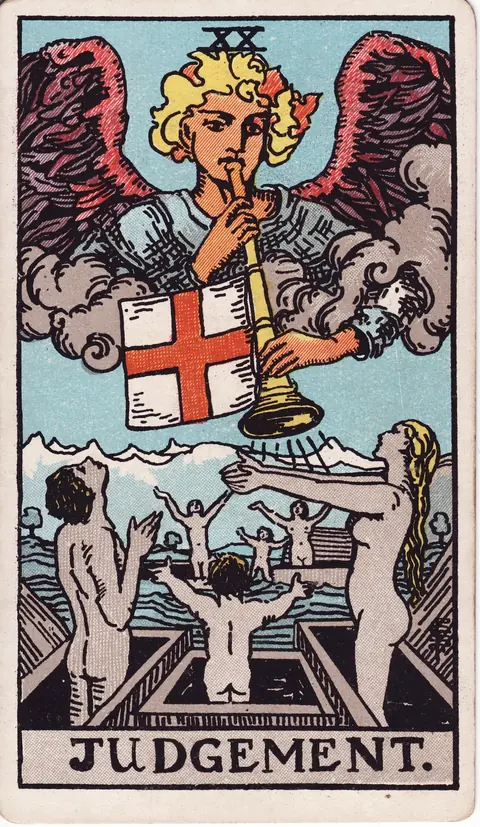
Justice brings fairness, truth, integrity into the reading. Judgement adds awakening, renewal, accountability. In a spread, identify which card describes the situation and which describes a response, influence or outcome.
If either card is reversed, compare its reversed interpretation too. A reversal can alter whether a quality is available, obstructed or expressed in a difficult way. The meanings are connected through the question rather than simply added together.
Practise those connections with How to Read Tarot Card Combinations and a three-card spread.
Timing
Justice predicts a significant event within the next 30 days. September 23 to October 22 is its associated period.
Yes or no
Justice gives no definite answer. The outcome depends on accountability, integrity and a fair decision. Consider whether the action upholds your values.
Number and astrological correspondence
Libra connects Justice with balance, judgement and the consequences of a decision. In Rider-Waite-Smith she is XI, reducing to Two. In a deck with Justice at VIII, she joins a different numerical family while retaining her named Libra correspondence in this scheme.
The printed number is 11. Under digit reduction it belongs to the 2 family: High Priestess, Justice and Judgement. Read the Major Arcana number-family guide for the complete groups and the method used to calculate them.
The Libra assignment comes from the Golden Dawn’s Book T. Our tarot and astrology overview explains how the planetary, zodiacal and elemental assignments differ. A correspondence adds to this card’s established meanings; use its position and orientation to decide whether it describes a condition, advice or a forecast.