A complete tarot reading begins with a question or an open intention and ends with a message you can take away. You prepare the deck, draw the cards, read them in their positions and connect their messages. A familiar routine helps you give the reading your attention without having to decide how to proceed at every step.
The method below works with a short spread or a Celtic Cross. It includes a hypothetical reading so you can see how preparation, interpretation and a forecast fit into one session.
Prepare your question and space
Put your deck, a notebook and the spread’s position meanings within reach. Choose somewhere you can see the pictures clearly and leave the cards undisturbed while you read. Give yourself enough time to finish the spread you have chosen.
Write your question before drawing. If you are asking about a developing situation, name the period you want to examine: “How is my move likely to unfold over the next two months?” If you want advice, ask for it directly: “What will help me prepare for this move?” Our question-writing guide offers more examples.
You can also read without a specific question. An open reading explores what most needs your attention. Decide that intention before shuffling, so you know whether you are looking for a broad message or answering something particular.
Take a moment to settle. You might say a prayer, greet your guides or simply hold the deck quietly. Use a ritual that belongs to your practice; you do not need to reproduce someone else’s ceremony.
Choose the spread and your approach to reversals
For a first full session, a three-card spread is enough. Choose its positions before drawing. Past, present and future gives a different reading from situation, challenge and advice.
If your question is predictive, give the spread a future or outcome position. An advice card shows an approach to take. An outcome card shows the direction the situation is taking under the conditions of the reading. Keeping those roles clear makes the eventual answer easier to understand.
Decide whether you will use reversed cards. If you read upright only, turn reversed cards upright as you lay them out. If you use reversals, keep their orientation and interpret it consistently throughout the session.
Shuffle, cut and lay out the cards
Shuffle while keeping the question or intention in mind. You can mix the cards between your hands, shuffle them on a table or use another method comfortable for the size and condition of your deck. Mixing cards on the table can introduce reversals; an overhand shuffle can preserve their orientation if you keep the packets facing the same way.
Stop when you feel ready. If cutting is part of your practice, divide the deck into smaller piles and bring them together again. There is no single cut every tarot reader must use.
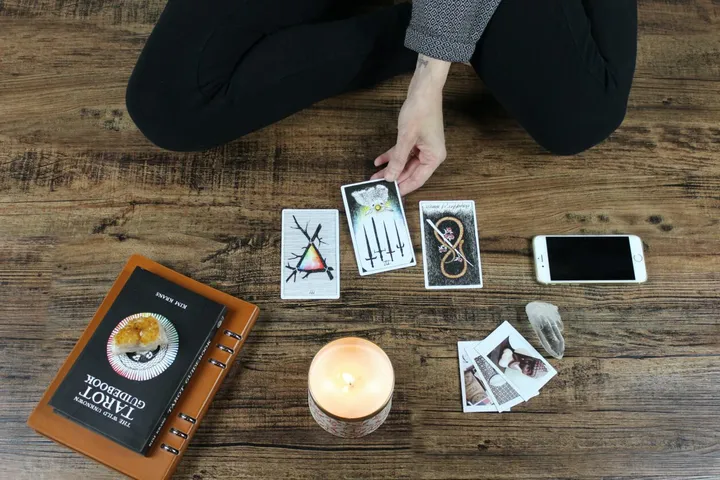
Draw the number of cards your spread requires. Place them in the numbered order you chose. Turn each card over sideways, like a page, if you want to preserve its original upright or reversed orientation. Flipping it end over end changes that orientation.
Read the position label as you place each card. A strong first impression can be useful, but give yourself time to see the whole spread before settling on an interpretation.
Read the cards individually, then together
Begin with what you notice: a figure’s posture, a repeated colour, movement across the spread or an unusually quiet scene. Then bring in the card’s established meaning. Keep your question and the position beside that meaning.
For example, the Four of Swords can describe rest or withdrawal. In a past position, it may show a pause you have already taken. As advice, it can ask you to step back now. In a future position, it may predict a quieter period ahead.
Look across the spread for connections. Are several cards concerned with work and money? Does one picture show movement while another shows resistance? Our card-combinations guide explains ways to read those relationships. A repeated suit can help identify the reading’s emphasis, but every card still has its own role.
You can look up meanings while you read. Choose the interpretation that fits the position and the other cards, including difficult meanings when they belong. If a card remains unclear, record that uncertainty rather than replacing it with one you prefer.
A complete example: preparing for a move
Imagine asking, “How is my move likely to unfold over the next two months?” You choose present situation, obstacle and likely outcome. All three cards in this imagined reading are upright.
| Position | Card | Interpretation |
|---|---|---|
| Present situation | Two of Pentacles | You are balancing costs, arrangements and the demands of ordinary life. |
| Obstacle | Four of Pentacles | Concern about security is making it difficult to release money, possessions or a familiar arrangement. |
| Likely outcome | Six of Swords | The move is likely to take you away from a troubled or tiring situation toward more manageable conditions. |
The two Pentacles cards make practical security central to the reading. The Four explains what makes the balancing act difficult. The Six of Swords brings movement into the outcome, but its subdued image suggests a transition that may carry mixed feelings.
A possible answer is: “The move is likely to go ahead and bring some relief, although organising your resources and leaving what is familiar will take attention.” The practical advice follows from the obstacle: decide what you need to retain and what you can afford to release.
That forecast answers the question and its two-month window. It does not establish an exact moving date or say that every worry disappears on arrival.
Close the session and keep the answer
Write down the question, date, cards, orientations and positions. Add your interpretation and a short statement of the answer. For a predictive reading, record what you expect to happen and the period involved. For advice, note what you intend to do.
Gather the cards when you have finished. You may shuffle to clear the reading, offer thanks or put the deck away quietly. Closing the session gives you a point at which to stop considering every possible meaning.
Return to the notes as the situation develops. What happened? Which card became clearer? Did a change in your actions alter the direction you first saw? A tarot journal keeps the original interpretation available for that comparison. When a reading leaves a question unresolved, examine its cards and positions before immediately drawing the whole spread again.
Further reading
Joan Bunning’s question-reading procedure describes a full session, and her lesson on connecting a reading into a story discusses bringing its messages together. The example here uses our Rider-Waite-Smith card meanings.