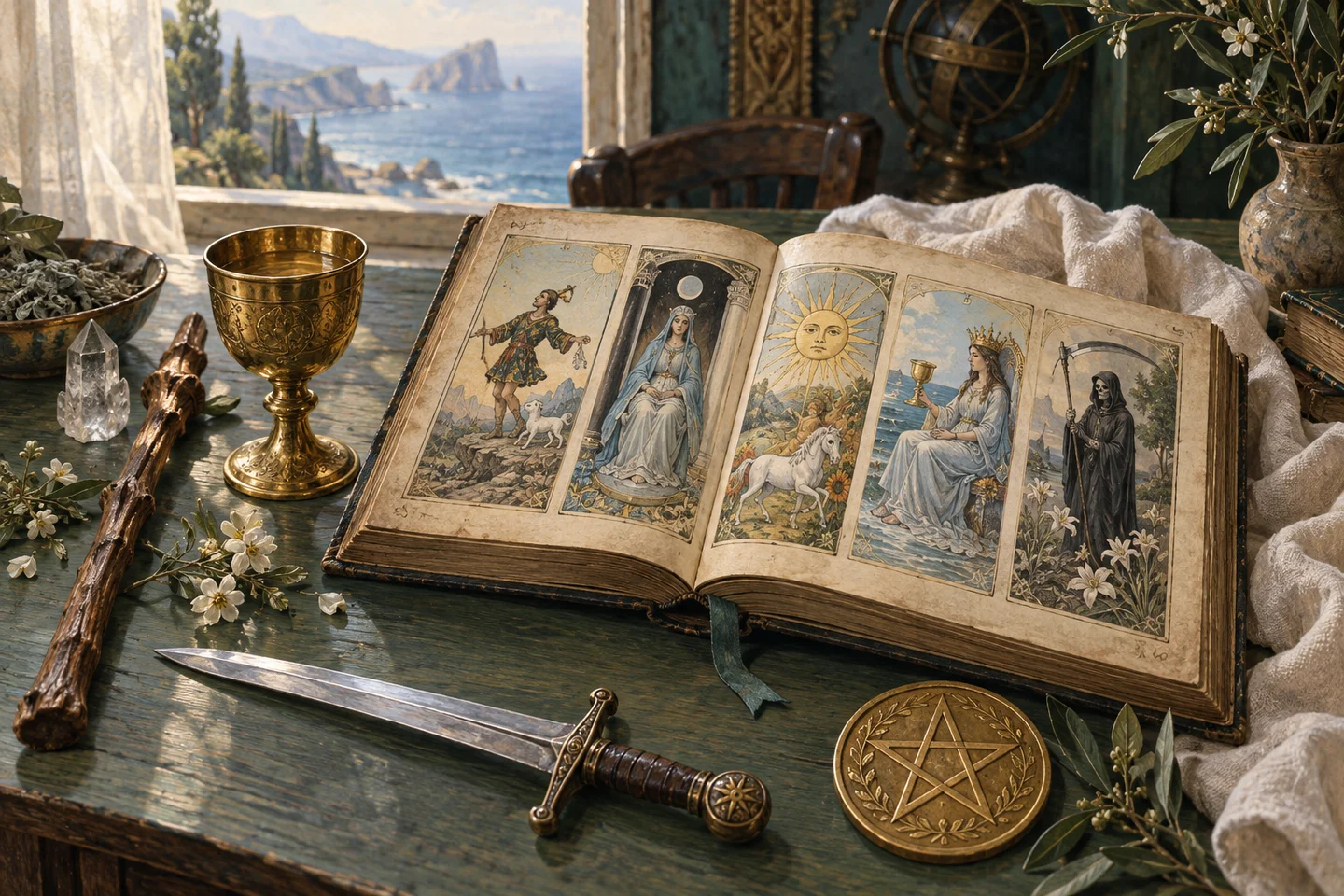
Tarot is a deck of 78 cards used for divination, guidance and exploring the patterns of a life. The pictures give readers a way to consider experiences, relationships and choices through symbols.
The deck has two main parts: the 22 cards of the Major Arcana and the 56 cards of the Minor Arcana. Understanding how those parts fit together gives you a starting point for learning the meanings.
The Major Arcana
The Major Arcana cards describe broad themes of human experience. Their figures include the motherly Empress, the authoritative Emperor and the solitary Hermit, alongside images such as the Sun and Moon. These are archetypes: recognizable patterns that can appear in many different lives and circumstances.
Most of the cards are numbered from I to XXI, with The Fool numbered 0. Readers also approach them as a sequence of experiences, often called the Fool’s journey. You can study the sequence while learning what each card suggests on its own.
The Fool introduces beginnings and the unfamiliar. The Hermit brings reflection and inner guidance. The World describes completion and fulfillment. In a reading, their themes take shape through the question and the other cards.
See the four suits together
The four Aces show how the same idea of a beginning changes with its element. Look at the object, the setting and the kind of possibility each card brings.
Fire · Wands
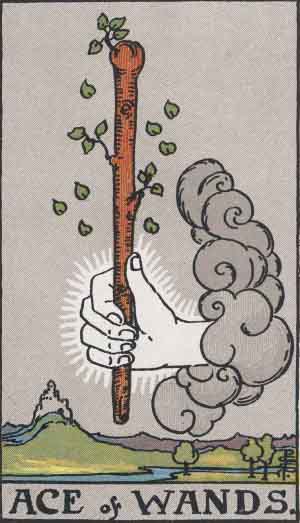
Ace of Wands
Inspiration, energy and the potential to begin something creative.
Water · Cups
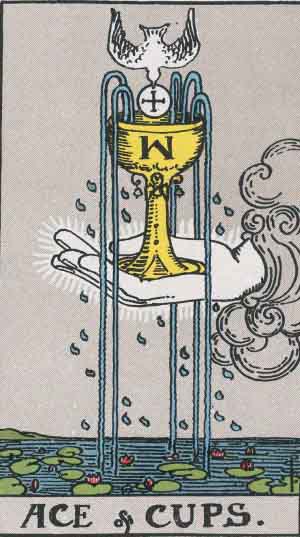
Ace of Cups
An emotional opening, affection or a creative feeling taking form.
Air · Swords
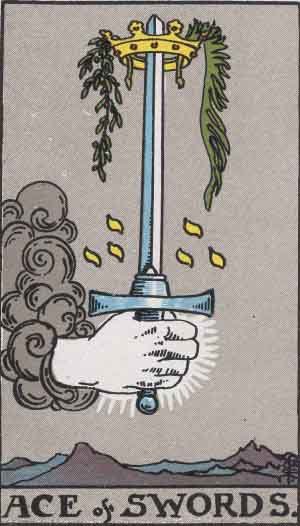
Ace of Swords
Clarity, a breakthrough or a truth that gives thought a new direction.
Earth · Pentacles
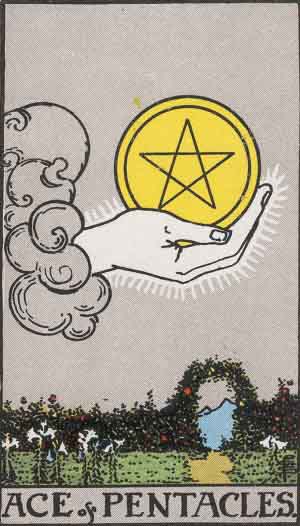
Ace of Pentacles
A practical opportunity involving work, resources or material growth.
A first comparison
All four cards offer potential, but they do not predict the same kind of beginning. A new feeling belongs to a different part of life from a new material opportunity. The suit gives the reading its first area of attention.
Read the Ace through the question before choosing among those possibilities. In a career reading, the Ace of Cups may concern meaningful or creative work, while the Ace of Pentacles may point towards a concrete opening. Their established meanings remain the basis of the interpretation.
The Minor Arcana
The Minor Arcana has four suits, each containing fourteen cards. The suits describe different aspects of daily life.
| Suit | Element | Common themes |
|---|---|---|
| Wands | Fire | Creativity, passion, action and ambition |
| Cups | Water | Emotions, relationships, imagination and intuition |
| Swords | Air | Thought, communication, decisions and conflict |
| Pentacles | Earth | Work, money, the body and material resources |
These associations help you connect a card with the subject of a reading. A Cups card can bring attention to the emotional part of a situation, while a Pentacles card may direct you toward practical concerns.
Each suit includes an Ace and the numbered cards Two through Ten. The numbers and the suit’s themes combine with the picture to give each card its meaning. The Ace of Cups, for example, introduces emotional possibility, while the Ten of Cups describes shared fulfillment and family harmony.
The court cards
The remaining four cards in each suit are the Page, Knight, Queen and King. Together, the sixteen court cards describe personalities and ways of expressing a suit’s qualities.
A court card may suggest a person, a quality you are using or the atmosphere around a situation. The question and surrounding cards help you decide which interpretation fits. You can recognize a quality in yourself even when the figure on the card differs from you in age or gender.
Compare the Page of Cups and King of Cups. Both concern emotional life, but the Page brings curiosity and a new emotional beginning, while the King suggests maturity and steadiness.
Read the picture as well as the meaning
Notice the people, objects, colors and setting on a card. Ask what is happening and which detail attracts your attention. Then read its guidebook meaning and compare it with what you saw.
You will gradually learn the established symbolism while developing your own understanding of the imagery. Our card meanings library gives descriptions, symbolism and upright and reversed interpretations for every card.
An upright card is one that appears right way up. A reversed card appears upside down and can be read as a different expression of its themes. You can begin by learning upright meanings and decide how you want to work with reversals as your practice develops.
Begin learning one card at a time
If you have not chosen a deck yet, read Choosing a Tarot Deck. Once you have one, use the daily practice in Getting To Know The Tarot Deck to become familiar with its pictures.
You can then try a one-card reading with a question of your own. The Learn Tarot pathway connects these guides in a sequence you can follow at your own pace.