
Keywords
Upright: Emotional harmony, discretion, generosity, empathy, wisdom, mature leadership.
Reversed: Emotional manipulation, volatility, deception, coldness, abuse of power.
Overview
The King of Cups is a wise leader and compassionate counselor. He understands the complexity of feeling without being overwhelmed by it. His calm can help others find their own steadiness, whether he appears as a therapist, mentor, guide or trusted person in your life.
His authority belongs to emotion and imagination. He has learned to manage them rather than suppress them, although that restraint can sometimes make him seem distant. He may be more interested in creating a useful way to help others than in openly expressing every feeling or displaying his own creativity.
A Closer Look at the King of Cups
Description
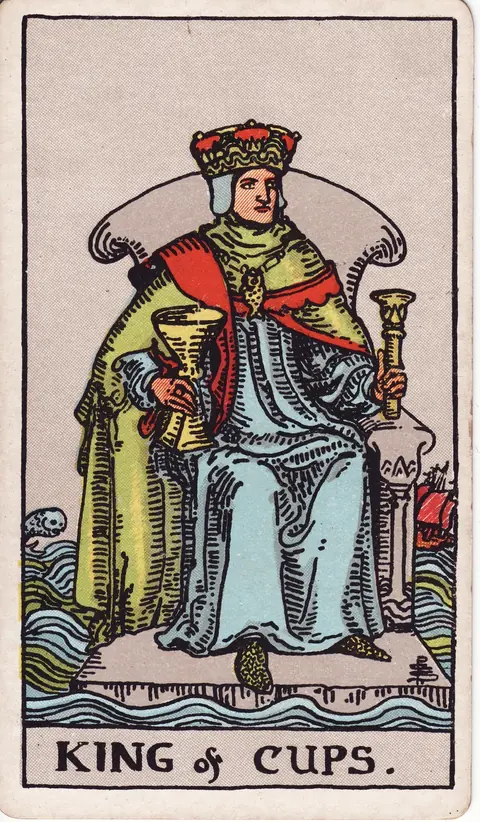
The King sits on a gray stone throne surrounded by a turbulent sea. He holds a cup and scepter, and a fish pendant rests at his neck. A ship sails nearby while a sea creature rises from the water.
The rough sea has not unsettled him. What normally remains below the surface has been allowed to emerge, but it does not control the throne. The image shows a mature relationship with unconscious impulses: the King recognizes his feelings, accepts them and chooses how to respond.
Meaning
The King of Cups can represent a powerful, generous and creative person whose private intentions are not always easy to read. Its archetype is Emotional Restraint, its astrological association is Cancer, and its Kabbalistic correspondence is Chockmah, or Wisdom.
Upright
Upright, the King brings friendship, generosity and practical help with emotional concerns. He may be confident in his dreams without feeling a need to explain every detail. His sensitivity is less openly expressed than the Queen’s, but it can still provide useful answers.
The card encourages calm in a crisis, willingness to help and openness to another point of view. It may describe a person of any gender or a compassionate, forgiving atmosphere that allows the situation to improve.
Reversed
Reversed, the King can be a false friend, manipulator or double-dealer. Charm and authority conceal motives that do not serve your well-being. Contradictory feelings may also be pulling you away from deeper spiritual concerns.
The reversal asks you to preserve honesty in your convictions and avoid cynicism or double thinking. Emotional authority becomes harmful when it is used to control rather than understand.
The Symbolism of the King of Cups
- The King’s posture: His open manner and composed gaze suggest sovereignty and satisfaction. He can remain present without being swept away by the surrounding sea.
- The throne on the water: Feeling and faith support his position. Spirit, dignity and awareness provide the symbolic buoyancy that keeps the heavy throne from sinking.
- The throne’s foundation: Longing and personal needs also support the King. Wishes are concentrated feelings, and understanding them is part of his command.
- The gray stone: Gray suggests calm, neutrality and an absence of prejudice. Its shadow is apathy, isolation or loneliness created by too much emotional distance.
- The sailing ship: A vessel needs ballast as well as movement. Managed burdens can stabilize the journey, while changing winds call for adaptability and a clear course.
- The sea creature: What is normally hidden becomes visible. The King’s dignity comes partly from understanding the impulses and feelings that rise from within.
- The fish pendant: Feeling can be carried outward and expressed. The symbol asks whether strongly felt needs have found a voice; its shadow is the constriction of keeping them unspoken.
- The cup: Alertness, integrity and attention to the present moment guide the King’s response. He recognizes wishes and concerns without allowing them to overwhelm the task.
- The scepter: Authority makes decisions possible. The King distinguishes desires worth pursuing and fears worth attending to from those that need not govern him.
- Red, yellow and blue: The primary colors connect him with original motives and aims. Their shadow is pursuing desires too narrowly and leaving greater potential unexplored.
What the King of Cups Means in a Reading
Meaning for Love and Relationships
Upright
If you are single, an emotionally stable, loving person is on the way. The companionship, affection or shared life you need will be offered, and you will feel cared for. Maintain the balanced outlook that helps you recognize this connection.
In a long relationship, you or your partner is taking greater responsibility for emotional well-being and for how you respond to one another. Compassion, kindness and stability are growing. This maturity is a favorable sign for the partnership’s future.
Reversed
Emotional instability may be making it difficult for one partner to treat the other with respect. Time and support may be needed to regain balance. In a harsher reading, the reversed King can signify betrayal, coercion, violence or sexual assault. If these circumstances are present, seek help to establish safety.
If you are single, the card can indicate an unavailable or married person, a cold or controlling potential partner, or someone whose charm conceals manipulation. In another reading, the difficulty is immaturity and dependence rather than calculated harm.
Meaning for Career
Upright
The King of Cups favors leadership that joins ambition with compassion. You may be mediating between different personalities or helping create a calmer workplace. A mentor can also help you balance professional goals with emotional needs and family life.
The card is associated with healing, counseling, medicine, work with children, volunteering, clergy, coaching and business mentorship. Care for others becomes useful professional skill.
Reversed
A cold, ruthless or emotionally unstable person may be causing trouble at work. The card can also ask whether your own behavior has taken on these qualities.
You may have chosen work for money alone and lost any sense of enjoyment. In a creative field, concern about status or wealth may be blocking expression. Reconnecting with the reason you loved the work will help creativity flow again.
Meaning for Health and Well-Being
Upright
The King of Cups may represent an experienced caregiver with a reassuring manner. This person can support you with physical symptoms while also understanding the feelings surrounding them.
The card asks for tenderness toward your body and a calmer emotional state. Greater steadiness helps you feel more secure as you attend to your well-being.
Reversed
The reversed King can indicate turning to alcohol or drugs when emotions feel overwhelming. Something in your habits or surroundings may be affecting health. Recognizing what is happening and accepting support allows you to begin choosing a more sustaining way to cope.
Meaning for Finances
Upright
The King of Cups asks you to take responsibility for your resources while remaining generous. Compassion has a place in financial life, and help given can return when it is needed. If you need assistance, ask rather than assuming you must manage alone.
Reversed
The reversed King warns of a con artist, extortionist or someone who uses emotional persuasion to obtain money. Be selective about whom you trust. Use qualified financial advice and verify unfamiliar people or arrangements before sharing resources or private information.
Timing
The King of Cups foretells a significant event in which intuition and emotion are first directed inward, then translated into action. Expect it in the coming weeks or months.
Dates associated with this card include October 13 to November 22.
Yes or No Questions
The answer is unclear. The King of Cups offers wisdom, intuition and sound guidance rather than a definite yes or no. Respond calmly, consider what experience has taught you and allow compassion to inform the decision.